Home Blog Page 291

The Outrageous Childhood Of the Semi-Mythical Viking-Poet, Egil Skallagrimsson


Egil Skallagrimsson was one of several prominent Vikings whose lives were recorded by the Icelanders in the form of a saga. Egil’s Saga was anonymously composed around the 13th century, with the Icelandic historian and scholar, Snorri Sturluson (1179-1241), being one of the likeliest authors of the piece. While most of Egil’s Saga is folklore and embellished history, many historians think that the plentiful poems contained in the saga may have indeed been written by a historical Viking-poet from the 10th century. So, like many other figures from the sagas, Egil Skallagrimsson is often considered to be a historical person whose reputation, over time, became exaggerated to the point of bordering on mythical.

A Strange Family

According to Icelandic tradition, Egil Skallagrimsson was born around the first decade of the 10th century and died within the last decade of the same century. In the saga, Egil’s father, Skallagrim fled to Iceland not too long after the rise of King Harald Finehair, who united Norway under his rule around 885 by defeating his last rivals in the Battle of Havsfjord. Skallagrim settled on the west coast of Iceland, north of modern Reykjavik, in a region known as Borgarfjord. Skallagrim built several farms there, as well as a forge, and a small community made up of family, friends and displaced Norwegian allies began to develop their own homesteads within Skallagrim’s land. It was here, in one of the settlements known as Borg, that Egil Skallagrimsson was born.

General Borgarfjord region (with the approximate location of Borg, derived from a 16th Century map of Iceland produced by Abraham Ortelius (1527–1598), [Public Domain] via Creative Commons.jpg

(General location of where Egil Skallagrimson would have been born. Derived from a 16th Century map of Iceland produced by Abraham Ortelius (1527–1598), [Public Domain] via Creative Common)

Egil was in no way average. Like most men in his family, he was tall and enormously strong. Unfortunately for Egil, he also inherited a condition suffered by a select few men in his bloodline—a visibly disturbing ugliness, accented by an abnormally thick head. Jesse Byock, a modern-day scholar and translator of Norse mythology and culture has suggested that this condition could have been caused by Paget’s disease, but the sagas had their own explanation for Egil’s distinct look. In the saga, Egil, as well as other members of his family that had his recognizable look, were allegedly shapeshifters of varying power. In fact, the saga heavily hints at that conclusion—Egil’s great-grandfather was named Bjalfi (animal skin) and the poet’s grandfather was nicknamed Kveldulf (Night Wolf). Furthermore, Egil Skallagrimsson and other members of his family were often described as looking and acting like wolves. These ugly shapeshifters also shared common personality traits, such as being moody and violent, especially after dark. Egil, personally, seemed to have been the runt of this supposed shapeshifter line. His visible abilities mainly manifested in remarkably unnatural facial expressions.

The Toddler-Poet

"The Journey" (cropped) painted by Elizabeth Shippen Green (1871–1954), [Public Domain] via Creative Commons

(“The Journey” (cropped) painted by Elizabeth Shippen Green (1871–1954), [Public Domain] via Creative Commons)

While growing up in Iceland, Egil developed his own impressive set of skills. The young poet gained an early reputation among his kinsmen for being an ambitious and independent boy that was unfortunately prone to frequent delinquency. One of his first adventures happened when he was only three years old. The event occurred when Egil’s grandfather, Yngvar, invited the family over to an alcohol-laden feast at his farm. Skallagrim decided to bring his wife Bera, and their oldest son, Thorolf, with him to the feast. Yet, he pointedly left young Egil behind, curiously telling the three-year-old boy “You’re enough trouble when you’re sober” (Egil’s Saga, chapter 31).

Egil, however, had set his mind on attending the feast, and that was exactly what he planned to do. Therefore, the ambitious toddler went to his father’s stable and hopped onto one of the more manageable horses. He then set off for his grandfather’s farm, only losing his way once or twice in the marsh. Nevertheless, the sun had already set by the time Egil finally entered his grandfather’s farmland, and all of the guests were already inside drinking around a table.

When Egil knocked on the farmhouse door, it was Yngvar who opened it and warmly welcomed his grandson inside. After Egil had told him that he had been left behind by his father, Yngvar led the young boy into the hall and sat him down protectively beside his own seat, which placed Egil directly across from Skallagrim and Thorolf. With Yngvar’s blessing, Egil joined the feast and all of the family members soon began to compete in a poetry competition.

Egil impressed the crowd with a poem that combined observations from the feast alongside lines about a dragon with a hoard of treasure. At the end of the skaldic verse, Egil even stuck in a proud boast about himself, claiming, “you’ll never find a better craftsman of poems three winters old than me” (Egil’s Saga, chapter 31). Yngvar deemed the poem worthy of reward, and gave a gift of three shells and a duck egg to the young poet. Egil was so pleased that he was inspired to compose yet another poem about the gifts. The resulting feat of poetry received even higher praise than the first.

Poetry would always remain an important aspect of the Egil Skallagrimsson’s life. It would not only be an art form for the future Viking-poet, but would also be a tool he used to save his own life. While most of Egil’s family was well spoken, the poet’s mastery of words was said to be so great that he could allegedly channel magic through his written runes and words.

Serious Sports

A scene of children playing from "Children's Games" (cropped and edited) painted by Pieter Brueghel the Elder (1526_1530–1569), [Public Domain] via Creative Commons

(A scene of children playing with sticks from “Children’s Games” (cropped and edited), painted by Pieter Brueghel the Elder (1526/1530–1569), [Public Domain] via Creative Commons)

The poet’s best friend during his early years on Iceland was Thord Granason, who was eight years his senior. Egil and Thord grew close largely because of their shared passion for sports. Egil had originally preferred wrestling, but because of Thord’s influence, he was eventually drawn to a game involving a ball and a wooden bat. When Thord was fifteen years old, he became the captain of the Borg village’s ball team. Egil, only seven years old at the time, was eager to play in an upcoming tournament that matched up athletes from different villages in Iceland. Thord had no problem at all with Egil competing; he even gave the young poet a ride to the venue, which was taking place in the plains by Laxfit, near to the rivers Grimsa and Hvita.

When the boys arrived, Thord directed Egil to where the young children were competing before he himself headed off to join the older participants. After Egil’s strength and ability were assessed, he was paired up against an impressively strong boy of ten or eleven years old, named Grim, who hailed from Myrar. The two played the game with a ball and bat, and it became quickly apparent that Egil was outmatched. Grim soon gained a lead, and he became so assured of his victory that he began to pander to the crowd, showing off his strength and skill at the young poet’s expense. Egil, growing increasingly embarrassed and angry, eventually took up his bat and tried to pummel his tormentor. Nevertheless, Grim, the older and stronger of the two, was able to disarm Egil and tackle him to the ground. When the angry poet was thoroughly pinned, Grim chastised Egil and told him to behave. Then, without another word, Grim went off to find another opponent.

Egil finally got up and brushed himself off. Under the weighty sneers and snickering of other onlooking boys, Egil stomped back to where the rest of the teammates from Borg were congregating. There, he found Thord Granason and told him about the embarrassing game he had just played. In a way, Thord’s response to Egil’s situation was commendable. He told the young poet to stand up against bullies. Unfortunately, this story was set in the Viking Age, so while telling Egil to stand up for himself, he simultaneously gave the young poet an axe.

Like a wolf, the seven-year-old poet stalked his prey. He unobtrusively sauntered over to where Grim was playing another game of ball and waited for a perfect time to strike. Soon, Grim caught a ball and a crowd of boys began to chase after him. Egil, with his axe, joined the chase, navigating through the runners to get nearer to his target. Then, when the time was right, young Egil hefted his axe and split Grim’s head as if it was a log.

The murder surprised everyone (except Egil and Thord), and before long the athletes from the various rival villages were all armed for battle. In the ensuing chaos, the saga claimed that six more men were killed, including Grim’s father and uncle. When Egil was escorted home by his fellow villagers, he faced mixed reactions from his parents. His father, Skallagrim, gave his son only passive-aggressive silence. Egil’s mother, Bera, merely mused that her son had the makings of a Viking.

As Egil kept growing, his abundance of strength became more and more prominent. By the time he was twelve, he was strong enough to defeat most adults in games. At the same time, Egil’s friend, Thord Granason (twenty years old by now), was also improving dramatically. The two became so skilled in sports (especially the ball game) that they could not find any serious competition that posed a challenge, well, except for the strongest man in Iceland—Egil’s own father Skallagrim. Ever since Skallagrim settled in Iceland, he had been the island’s undisputed champion of strength and sport. As such, Egil and Thord tested themselves against the aging champ often and for long periods of play. Nevertheless, even when ganging up, two against one, Egil and Thord could never defeat Skallagrim.

On a certain winter day (while Egil was twelve and Thord was twenty), Egil and his friend finally started to pose a threat to Skallagrim. They played ball all day long at a place called Sandvik, and the boys began to wear down their elder. As the sun started to go down, Egil and Thord thought that their long-awaited victory was near. As soon as the sun set, however, Skallagrim (who the saga hints to be a shapeshifter) seemingly regained all of his strength and stamina. Yet, in exchange, the old man lost all self-control. Under the moonlight, and in the heat of competition, Skallagrim tackled Thord with such excessive force that the young man was instantly crushed to death. Now in a bloodlust, Skallagrim snatched up his twelve-year-old son and made ready to thrash him to death.

At that moment, a village woman named Thorgerd Brak appeared just in time to save Egil’s life. She was an impressive woman of great strength and an even greater knowledge of magic. Thorgerd distracted Skallagrim by shouting that he was behaving like a deranged animal. The yell did not bring Skallgrim back to his senses, but it did cause him to drop Egil. Unfortunately for Thorgerd, Skallagrim’s attention was now solely on her. Thorgerd may have been strong in magic and might, but when she realized that she was now Skallagrim’s prey, she decided to run toward the shore. Miraculously, she was able to dive into the waters of the fjord before her pursuer caught up. Nevertheless, she still did not escape. In the saga, the still crazed Skallagrim lifted up a nearby boulder and, with impressive accuracy, threw the massive rock on an arc that ended directly on top of Thorgerd, pinning her forever underneath the water.

Despite all of the horrendous drama that occurred that night, both Egil and Skalagrim made it home in time for the evening meal, attended by the whole household. Egil was the last person to arrive at the table. He was so infuriated at the death of his best friend, and at nearly being mauled to death by his own father, that he said not a word when he entered the room. Instead, he strode in a silent rage up to where Skallagrim’s favorite farmhand was sitting. To avenge Thord’s death, Egil slew this unnamed employee and then broodingly found his seat. Skallagrim, his earlier rage gone, kept silent during this display. Likewise, Egil refused to speak to his father. This battle of silence continued for the remainder of the winter, with neither father nor son willing to talk to the other.

It was not long after this incident, that Egil decided to leave Iceland. The next summer after the death of Thord, Egil’s brother, Thorolf Skallagrimsson, momentarily returned to Iceland after spending time in Harald Finehair’s kingdom of Norway. When Egil asked if he could join Thorolf’s crew, the young poet was flat-out denied—Thorolf rightly thought that Egil would get himself in too much trouble in Norway. The mischievous teen, however, was determined to change his brother’s mind. The tactic he chose was sabotage, warning Thorolf that he would only be able to leave Iceland if the brothers left together. The ambitious poet even went to the extent of cutting the ropes on his brother’s ship and letting the empty vessel float away into the fjord. In the end, when Thorolf recovered his ship and departed Iceland again, he took his young brother with him out into the chaotic world of Viking Age Scandinavia and Britain. But that is a different story for another time.

Written by C. Keith Hansley.

Top Picture Attribution: (Ingolf settling Iceland, painted by Johan Peter Raadsig (1806 – 1882), [Public Domain] via Creative Commons).

Sources:

Cassius Dio


Cassius Dio (c. 163-235)

“Much of what a ruler does to punish men for alleged conspiracy against him, whether he takes action personally or through the Senate, is suspected to have been prompted by spite, however well justified it may have been.”

  • From Cassius Dio’s The Roman History (Book 54, chapter 15), translated by Ian Scott-Kilvert (Penguin Classics, 1987).

King Alfred Of Wessex Was Not Widely Recognized As “Great” For Over 600 Years Until The 16th Century


The recognition of King Alfred (r. 871-899) of Wessex as one of the greatest kings of British history is a generally recent phenomenon. Make no mistake, despite the absence of “the Great,” Alfred was still seen by his immediate peers and successors as a skilled ruler, a powerful war leader and a wise administrator of his realm. After all, he was a very successful king. In 871, King Alfred found himself in possession of a kingdom on the verge of collapse. His lands were threatened by roving bands of Vikings who traveled from one British kingdom to another, killing or extorting protection money from the battered monarchs. Although his reign began shakily, Alfred eventually pushed multiple waves of Vikings out of his domain and achieved recognition as the leading king of the surviving Anglo-Saxon states that were threatened by the Vikings. By the end of his reign, Alfred had put in place an efficient system of defense against the still-present Viking threat and initiated an educational renaissance in his lands. Yet, in the centuries following his death, despite his contributions to the survival of the Anglo-Saxon kingdoms in England, Alfred was only considered as one good and effective king among a line of other exceptional kings—not yet a “great” king.

Alfred’s postmortem fame suffered from the successes of his family, both preceding his reign and following his death. Alfred’s grandfather, King Egbert (or Ecgbert, r. 802-839), was one of the top contenders that siphoned away Alfred’s fame. King Egbert was the one who originally put the Kingdom of Wessex on the path to greatness by making his kingdom the most influential power in the region of England, with most of his neighboring kingdoms either deferring to his will or being outright controlled by Wessex.

King Alfred, following the reigns of his father and brothers, succeeded in keeping Egbert’s hegemony over England intact, but he did not annihilate the Viking presence in Britain. Instead, Alfred ruled southern England and brought parts of Wales over to his side, while the Vikings were restricted to the Danelaw, a region carved out by the Scandinavians in the north and mid-east of England. Alfred’s fame was further chipped away by the successful reigns of his own son and grandson. Alfred’s grandson, King Æthelstan (r. 925-939), especially stole Alfred’s limelight by defeating the Norse-Celtic alliance and achieving the status of being the first king to bring all of England under his control. In short, Alfred’s greatness was often overlooked by medieval observers simply because the Kingdom of Wessex was in a golden age of competent kings during the 9th and early 10th centuries.

Nevertheless, King Alfred the Great eventually received his due. The earliest references to Alfred as “the Great” (that are known to this author) have been dated to the 15th century. Before this, Alfred had been treated with respect, often described as wise, magnanimous, or as a king of all the English/Anglo-Saxons. Unfortunately for Alfred, even when he was awarded the title of “the Great” in the late Middle Ages, it still was not in commonplace usage. Actually, Sir John Spelman is credited with popularizing the name, “Alfred the Great,” as a result of his work, Life of Alfred the Great, which was published postmortem in Latin (in 1678) and later in English, in 1709.

Interestingly, the very first biography written about King Alfred may have also played a role in the king’s late rise to greatness. A welsh monk, bishop and courtier of King Alfred, who went by the name of Asser, wrote the first known biography about an Anglo-Saxon king, which happened to be King Alfred. He is believed to have begun writing the piece around 893, eventually producing what is now known as Asser’s Life of King Alfred. As biographies go, it was not the best—with the utmost respect to Asser, the book was left unfinished, unedited, and critics would not be too imprecise to accuse the text of being poorly written. Asser, himself, likely knew the biography was not up to par, for it seems likely that he abandoned the project. Fifteen or sixteen unproductive years passed from the beginning of the biography in 893 to the death of Asser in 908 or 909. There is no evidence that Asser attempted to have his unfinished manuscript published on a large scale within England, not to mention dissemination of the work to other countries.

Ironically, either to Asser’s delight or horror, Asser’s Life of King Alfred is now considered to be one of the most important and valuable texts about King Alfred and the Anglo-Saxon world in England. Although all of the few known original medieval copies of the text have been lost (the last burned in 1731), modern presses have kept the work alive, preserving great insight into the extraordinary life and character of King Alfred the Great.

Written by C. Keith Hansley.

Picture Attribution: (Portrait of Alfred the Great by Samuel Woodforde (1763-1817), [Public Domain] via Creative Commons).

Sources:

Tacitus


Tacitus (c. 56/57-117)

“Men’s minds, once unbalanced, are ready to believe anything.”

  • The Annals of Imperial Rome (I.28) by Tacitus, translated by Michael Grant. New York: Penguin Classics, 1996.

The Horribly Unsuccessful Political Career Of Parthian King Vonones I


Vonones was a Parthian prince who, although he managed to seize two thrones during his life, was unfortunately always outmaneuvered by his enemies. His father was the Parthian king, Phraates IV (r. 38-2 BCE), who after making peace with Augustus (r. 31 BCE – 14 CE), sent the Roman dictator several of his sons (including Vonones) as hostages, in a display of peace and respect. Therefore, Prince Vonones grew up with a thorough dose of Greco-Roman culture that would stay with him for the rest of his life. From the luxury of Rome, Vonones could only listen as reports came in of his father being murdered, followed by the short reign of Phraates V, and then the even shorter reign (mere months) of Orodes III. After the death of Orodes III, the Parthians were in need of a new monarch, and luckily enough, they had several members of the Parthian royal line living in the Roman Empire. Therefore, a party of diplomats from Parthia soon arrived in Rome to petition the emperor to allow Vonones to return home and become king of the Parthians. The Romans, thrilled at the thought of having a pro-Roman king leading the Parthians, sent Vonones home to be crowned.

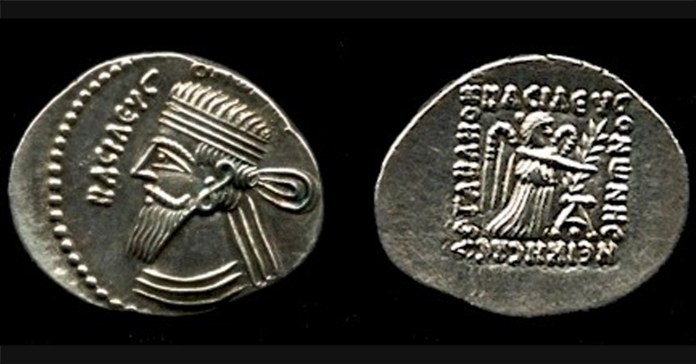
The exact date of King Vonones’ reign remains in debate. Almost all scholars agree that he was politically active in the first two decades of the 1st century CE, with 8/9-11/12 (give or take a few years) being the usual dates given for his time of rule in Parthia. He seemed to have been a well-educated man, who brought his Greek and Roman teachings with him to Parthia. For instance, he minted coins in which his name was stamped in Greek. The new king’s noticeable Romanization, however, quickly became a problem among his subjects. The Roman statesman and historian, Tacitus (c. 56-117), claimed that Vonones I was uninterested in the local Parthian culture and tradition. Unlike his countrymen, the king did not care for horses. Similarly, while he enjoyed being carried around in a litter, he supposedly detested the Parthian-styled banquets that were expected of him. Also, instead of filling his court with local Parthians, he was said to have imported Greeks and Romans to serve as his government advisors. As these differences between ruler and subjects continued to persist, both sides began to look at the other as something entirely alien.

In the end, the Parthians rallied behind a rival king named Artabanus III (r. 11/12-38) and Vonones I was forced to flee from his kingdom. With remarkable timing, he then found shelter in Armenia, which miraculously happened to be a kingdom without a king. Curiously, Vonones was able to quickly place himself upon the Armenian throne. Yet, the Parthians did not like that Vonones had found a new kingdom, especially one that neighbored their own empire. The refugee king in Armenia also threatened the uneasy relationship between the Roman and Parthian Empires, for which the Kingdom of Armenia served as a buffer state. Eventually, around the year 15 or 16, the Roman governor of Syria became so concerned about the situation that he had Vonones seized and placed him under luxurious house arrest in the Roman Empire.

According to Tacitus, Vonones remained under house arrest in the Roman province of Syria until the year 18, when Emperor Tiberius’ adopted son, Germanicus, had the twice dethroned monarch moved to the town of Pompeiopolis, a settlement on the coast of Cilicia. This was apparently done as a diplomatic gesture to Parthia after King Artabanus III had accused Vonones of leading intrigues from his luxurious prison in Syria. Unfortunately, the new location in Pompeiopolis must not have been up to Vonones’ standards, for he attempted to escape in the year 19. He was reportedly attempting to flee to relatives in the lands of the Scythians when Roman troops caught up. Sadly, Vonones apparently had outlived his usefulness, for he was killed during or shortly after being apprehended.

Written by C. Keith Hansley.

Picture Attribution: (Coin of Vonones I of Parthia with Greek inscriptions from the mint at Ecbatana. The reverse shows Nike with a palm, [Public Domain] via Creative Commons).

Sources:

Sun Tzu


Sun Tzu (This quote recorded between the 6th and 3rd century BCE)

“Command is
Wisdom,
Integrity,
Compassion,
Courage,
Severity.”

  • From Sun Tzu’s The Art of War (Chapter 1), translated by John Minford (Penguin Classics, 2009).

Charles The Fat Gobbled Up The Lands Of His Relatives And Recreated Charlemagne’s Empire, All Without Much Effort


After the death of Emperor Louis I “the Pious” in 840, Charlemagne’s Carolingian Empire in Europe was divided among Louis’ sons. Although the empire of the Franks had fractured, a grandson of Louis the Pious would unexpectedly reunite most pieces of the Carolingian Empire under one administration. Adding to the impressive achievement, the reunification was done almost entirely without bloodshed.

The protagonist of the Carolingian Empire’s reestablishment was an unassuming man named Charles III (r. 876-887), also known by the unfortunate epithet of Charles the Fat. He lived in a time of great rulers, with contemporaries such as King Alfred the Great in England and King Harald Finehair in Norway. While Alfred and Harald were both sublime leaders who earned their prestigious places in history through military grit and administrative skill, Charles the Fat was a different kind of leader—his unification of the fractured Carolingian Empire happened seemingly by pure luck.

Charles the Fat began his rise to power in 876, upon the death of his father, Louis the German. Charles was one of three sons who inherited land after his father’s death. He became king of Alemania (later renamed Swabia), Alsace and Rhaetia, ruling a large swath of land in lower Germany and along the Rhine. Charles’ brother, Louis the Younger, took control of northern Germany, most notably Saxony. Similarly, the Carolingian holdings in Italy were granted to another brother named Carloman.

Charles the Fat’s first major territorial expansion occurred in 879, when he took over control of the Carolingian lands in Italy after his brother became fatally ill. The pope at the time, John VIII, must have approved of the new king, for he granted Charles the title of Holy Roman Emperor in 881. A year later, in 882, Louis the Younger also died. As a result of the death, Charles the Fat inherited his late brother’s northern German lands. In around 3 years, Charles had grown from a relatively average king into an emperor who ruled Germany and northern Italy.

Nevertheless, the emperor’s good fortune continued. In 884, Carloman II of France met an inglorious end while hunting boar. As there were no other legitimate descendants of Charlemagne’s line currently fit to rule, it was agreed by June 885 that the French lands would also be ruled by Charles the Fat. In only 9 years, a monarch in lower Germany spread his influence to encompass much of Germany, Italy and France—and he did this by simply waiting for his relatives to die.

For most of his reign, Charles the Fat had to deal with persistent armies of Vikings. The Scandinavian raiders who had been ravaging Britain decided to take a sabbatical from their wars with the Anglo-Saxons and arrived in force around 879 to try their luck against the Franks. Many of the raiders would not return to Britain until about 892. While Frankish regional leaders won several military victories against the Vikings, Charles the Fat personally responded poorly to the invaders. For the most part, his favorite tactic against the Vikings was bribery. Payment of tribute did, indeed, have a role in persuading the Vikings to break off their siege of Paris (c. November 885 – November 886), but the king’s appeasement did little to instill confidence in his subjects.

The downfall of Charles the Fat came in 887. During that year, the emperor’s nephew, named Arnulf, revolted against Charles’ rule, claiming Germany as his own kingdom. Charles, who was likely suffering from illness at the time, was formally deposed in November 887. He did not last long after his power was usurped and died in early 888. The empire that he had rebuilt quickly crumbled into individual kingdoms shortly after his death. In the power vacuum, Arnulf kept Germany for himself. Count Rudolph laid claim to most of Burgundy. Count Odo in Paris became the king of France. The count of Friuli, named Berengar, seized northern Italy and Guy, the duke of Spoleto, claimed the Italian south.

Written by C. Keith Hansley.

Picture Attribution: (Portrait of Charles the Fat painted by Louis-Félix Amiel (1802–1864), [Public Domain] via Creative Commons).

Sources:

Thucydides


Thucydides (c. 460-400 BCE)

“What I fear is not the enemy’s strategy, but our own mistakes.”

  • History of the Peloponnesian War (Book I, section 144) by Thucydides, translated by Rex Warner (Penguin Classics, 1972). The quote comes from a speech that Thucydides wrote while in the character of Pericles.

Apuleius


Apuleius (c. 125-170/180)

“What nobody knows about to all intents and purposes hasn’t happened.”

  • From The Golden Ass or Metamorphoses (Book 10) by Apuleius, translated by E. J. Kenney (Penguin Classics Edition).

The Obsessively Pure Life Of Saint-Queen Etheldreda And Her Miraculous Remains


Etheldreda (also known by the names Æthelthryth and Audrey) was one of the most popular saints to come out of early Anglo-Saxon England. In particular, she found an admirer in Bede (c. 673-735), the author of the Ecclesiastical History of the English People, which recorded events in England from the days of the Roman Empire up to Bede’s own time; in it the monk included a chapter on Etheldreda, drawing largely from clergymen who had known the saint, specifically her friend and mentor, Bishop Wilfrid.

King Anna of East Anglia (d. 654) fathered several saintly daughters, one of which was Etheldreda. The young princess was said to have begun dreaming about life as a nun relatively early on in her childhood. Even though she was not allowed to join a religious order, she reportedly still tried to live with extreme virtue. Most importantly, she vowed to live in chastity and remain a virgin. Despite her vow, noblemen still sought her hand in marriage, for the union (even if only symbolic) would still bring the prospective husband into an alliance with the East Anglian king. Therefore, Etheldreda was married to a certain Tondbert, a prince or king from South Gyrwas. Apparently, the couple struck up an accord—she received her own estates, he became the king’s son-in-law, and neither husband nor wife bothered about consummating the marriage. As such, when Tondbert died shortly after the marriage had occurred, Etheldreda was still widely considered to be a pure virgin princess.

Unfortunately for Etheldreda, that meant she was still an eligible pawn in the political marriage unions of antiquity. Her second husband was Ecgfrith (also known as Egfrid), a future king of Northumbria. The two were married sometime before Ecgfrith took the throne, and he was still rather young when the match was made. Again, Etheldreda made her vow of chastity known to her husband, claiming that she was there for politics, not for procreation. At the beginning of the marriage, young Ecgfrith seemed willing to put up with his wife’s strict abstinence. Yet, in 670, he became the king of Northumbria, and as a king, it was vital to obtain heirs. Therefore, he began to pressure Etheldreda to come to bed, and when his propositions failed, he was desperate enough to offer Bishop Wilfred land and treasure if he could somehow manage to sway the queen to break her vow of chastity. Yet, every scheme failed, and the queen was said to have remained strictly chaste for all 12 years (c. 660-672) that the two were married.

Eventually, Etheldreda either convinced King Ecgfrith to let her join a religious order, or ran away to escape his urges. Whatever the case, the marriage was eventually annulled (around 672) and Etheldreda joined the convent of Coldingham, where she officially became a nun. She quickly left from there and returned home to East Anglia, where she became an abbess of her own convent, in the region of Ely.

Meanwhile, King Ecgfrith remarried and attempted to expand his realm. He was an ambitious king, but he had little success in his endeavors. He conquered the region of Lindsey from the kingdom of Mercia in 674, only to relinquish it back to the Mercians after losing a battle at the River Trent in 679. He launched an unadvised invasion of Ireland in 684, followed by another unwise expedition against the Picts in 685. During this later campaign, he died in battle at Nechtansmere (modern Forfar, Scotland).

While her former husband was seeing to his kingdom, Etheldreda was living the life of a devout nun. While at Ely, she made a name for herself as a virtuous ascetic. She allegedly wore only wool clothing, and refused finer textiles. She scorned the luxury of hot water for bathing, and only allowed her baths to be heated on the eves of important religious festivals. As for her diet, she was said to eat only one meal per day, yet she did sometimes let herself indulge on holidays. Etheldreda was also said to have been blessed with the gift of prophecy; however, this meant she had the unfortunate ability to see her own impending death.

Around 679, Etheldreda fell severely ill with a large and painful red tumor somewhere on her neck, underneath her chin. Modern observers have suggested that she may have suffered from quinsy, an infection of the tonsils. No matter what the illness was, Etheldreda seemed to face it with poise, even joking that the ugly abscess bulging from her neck was punishment for all of the expensive necklaces that she had worn during her days as a noblewoman and queen. Nevertheless, after days of agony, Etheldreda finally found relief in death.

Yet, the saint’s tale was far from over. After a span of 16 years, Etheldreda’s sister, Sexburg, exhumed the body of the saint in order to move her remains inside a nearby church. During the process, the coffin was opened and all onlookers (including Bishop Wilfrid) were astonished—Etheldreda’s body was still perfectly preserved, and her tumor even looked partially healed. The burial sheets and her clothing also allegedly still seemed as fresh as they had on the day she was entombed. These old sheets and garments were taken away and the saint was outfitted with new burial clothes before being sealed away in a specially designed sarcophagus. The textiles that were taken from her tomb were said to have had the power to exorcise demons. Even more miraculous, people who suffered from blindness or eye pain could allegedly be cured by running their hands along Etheldreda’s tomb, especially if they could manage to touch the wood of her coffin. Today, Etheldreda is considered a pre-congregational saint (predating modern Catholic canonization processes), and is regarded as a patron for widows and sufferers of neck ailments.

Written by C. Keith Hansley.

Picture Attribution: (cropped 10th century depiction of Saint Æthelthryth (Etheldreda) of Ely from the Benedictional of St. Æthelwold, illuminated manuscript in the British Library, [Public Domain] via Creative Commons).

Sources: