Home Blog Page 58

A Priest Of Aphrodite Halted A Persian Invasion Orchestrated By Shapur I

Shapur I (r. 239/242-270/272), of the Sasanian Persian Empire, had a long reign filled with impressive military successes, including the besting of at least three Roman Emperors (Gordian III [r. 238-244], Philip [r. 244-249] and Valerian [253-260]), the last of which was captured by the Persians and paraded around Shapur’s court as a living trophy. Amid Shapur’s record of conquests and expansions, however, was a curious blemish of defeat inflicted on the Persian forces by an unlikely leader who won a battle against Shapur’s forces near Emesa around 252 or 253. The battle took place during a campaign of warfare launched by Shapur I against the Roman Empire around 252. Shapur’s campaign targeted Syria and Anatolia. As a result, Emesa, located at the Homs Gap between Aleppo and Damascus, was an early objective that Shapur wanted to take. Nevertheless, a local force from the Emesa region quickly mobilized, marched south, and set up a defensive position before the Persians arrived. The Emesan troops, curiously enough, had as their leader a man named Uranius Antoninus (also known as Sampsigeramus), who was said to have been a priest of the love goddess, Aphrodite. To Shapur’s chagrin, the priest of Aphrodite and his Emesan forces were able to hold the Homs Gap and halt the Persian army.

Shapur’s military campaign, however, was no way near its end—instead, this particular campaign would stretch on to 257, and, unfortunately for the Romans, the Persians would ultimately be successful. That aside, the officers involved in the Emesan victory over the Persians immediately leapt into politics and their local army launched a bid to set their leader up as a new emperor of Rome. The priest of Aphrodite may have been involved in the insurrection, but the identities of the usurpers at Emesa are vague and contested. Whatever the case, there were bigger fish in the sea—Septimius Odaenathus of Palmyra, who was given great power by Emperor Gallienus of Rome (r. 260-268), crushed the rebel army at Emesa and brought the region under the influence of Palmyra. This same Odaenathus was able to halt Shapur’s renewed advances against the Roman Empire, defending the regions of Mesopotamia and Armenia from Persian attacks. When Odaenathus and his eldest sons were assassinated, the powerful Palmyrene regime declared independence under the rule of Queen Zenobia of Palmyra (r. 267/268-272). The aforementioned city of Emesa joined Zenobia’s upstart empire. Zenobia’s revolution, however, was defeated by Emperor Aurelian of Rome (r. 270–275), who absorbed the region back into the Roman Empire.

Written by C. Keith Hansley

Picture Attribution: (Venus tells Aeneas and his friend Achates to go to Carthage, designed by Giovanni Francesco Romanelli (c. 1610–1662), [Public Domain] via Creative Commons and the Cleveland Museum of Art).

Sources:

The Tenth Day Of The Decameron, Painted By Thomas Stothard (c. 1755-1834)

This Painting, by the English artist Thomas Stothard (c. 1755-1834), brings to life the framework story of The Decameron, a masterpiece of literature written by the Florentine author, Giovanni Boccaccio (c. 1313-1375). The Decameron was set in 1348, when the Black Death was rampaging across Europe. To escape the plague, a group of seven women and three men found shelter in an abandoned villa, where they were able to ride out the epidemic in luxury. So as to not be overcome by boredom during their isolation, the group of ten decided to occupy their time by telling each other stories. As all ten members of the group told a story every day, they had cumulatively narrated a hundred tales once their tenth day in the villa was over. Giovanni Boccaccio described the scene when one of the refugees in the manor, a woman named Pampinea, first proposed this storytelling scheme to her companions in their hideaway mansion:

“For the moment, it would surely be foolish of us to venture abroad, this being such a cool and pleasant spot in which to linger. Besides, as you will observe, there are chessboards and other games here, and so we are free to amuse ourselves in whatever way we please. But if you were to follow my advice, this hotter part of the day would be spent, not in playing games (which inevitably bring anxiety to one of the players, without offering very much pleasure either to his opponent or to the spectators), but in telling stories—an activity that may afford some amusement both to the narrator and to the company at large” (The Decameron, introduction).

Such is the reason for why the group of ten was spending time together in an abandoned villa. As the title of the artwork states, the artist chose to depict the storytellers on their tenth and final day in their villa. That morning, the group gathered to lounge by the compound’s gardens and share in each other’s company over some refreshments. As told by Giovanni Boccaccio, “Gathering round the fountain, they had some glasses rinsed in its limpid waters, and those among them who were thirsty drank their fill; after which they roamed freely through the garden, savoring its delectable shade, until the hour of breakfast” (The Decameron, introduction to the Tenth Day). It should be said that the painting is not quite accurate in its depiction of the storytellers’ numbers and male-to-female ratio. The storytelling group in Giovanni Boccaccio’s Decameron was made up of ten people (seven women and three men), whereas the painting contains eleven people (seven women and four men). One can imagine, however, that the extra man could be an attendant.

Written by C. Keith Hansley

Sources:

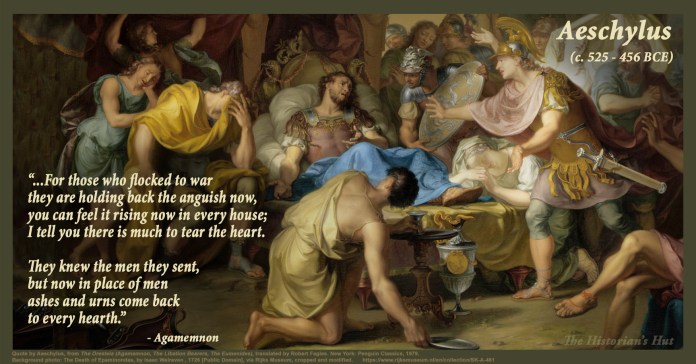
Aeschylus

Aeschylus (c. 525-456 BCE)

“…for those who flocked to war
they are holding back the anguish now,
you can feel it rising now in every house;
I tell you there is much to tear the heart.

They knew the men they sent,
but now in place of men
ashes and urns come back
to every hearth.”

  • From Aeschylus’ Agamemnon (approximately lines 425-435), translated by Robert Fagles. New York: Penguin Classics, 1979.

The Lesser-Known Tale Of Helen Never Actually Going To Troy

Queen Helen of Sparta came to be known as Helen of Troy because of the legendary story involving her being taken or lured away from her husband, Menelaus, by Prince Paris of Troy. This incident sparked the Trojan War between the Greeks and Trojans, and garnered Helen a tarnished reputation among the Greek population. Despite Helen’s legacy as the greatest beauty of her age—the face that launched a thousand ships, as it were—there was more to the Spartan queen than her looks. She was a daughter of Zeus, making her a demigoddess, and some ancient storytellers wondered if there was more to the story than Helen’s usual characterization as the flippant queen or the damsel in distress. In fact, Euripides (c. 485-406 BCE), a playwright who wrote some of the strongest roles for women, preserved a tradition of the myth in which Helen was saved by the gods from the disgrace of being kidnapped by Paris. According to this version of the story, she was actually in Egypt for the entirety of the Trojan War. Unfortunately, although the gods saved their kinswoman, Helen, from personal defilement, they could not do the same for her reputation. In Euripides’ play, Helen tells the audience:

“Hera, taking it amiss that she had not won the divine beauty contest, turned my marriage to thin air for Alexandros [aka Paris] and gave to the son of King Priam not my real self but a breathing phantom which she had moulded in my likeness from heavenly ether…As for my real self, Hermes took me up and hid me in the clouds in the upper air’s embrace—for Zeus did not cease to care about me—and brought me to live in this house of Proteus [in Egypt], the man he had judged the most virtuous of all mortals, so that I could keep my marriage with Menelaos undefiled” (Euripides, Helen, approximately lines 30-50).

Such was the way Euripides attempted to do damage control with the stories of Helen and the gods involved in her life. In this version of the story, rather than the gods allowing Helen to be tossed around like a prize, Euripides instead envisioned Helen’s godly relatives making some effort to somewhat protect her from what fate otherwise had in store. After the Greeks completed their harrowing years-long campaign against the Trojans, Menelaus, on his journey home, was driven off course to Egypt. This occurred in the original tellings of Trojan War stories and Helen was with him during the unexpected adventure. In Euripides’ version of the tale, however, it was the fake phantom version of Helen that Menelaus possessed before arriving in Egypt. During his Egyptian stop, so the story goes, Menelaus was separated from the convincing phantom and was subsequently reunited with the real Helen.

Written by C. Keith Hansley

Picture Attribution: (Cropped black Figure Amphora with a Marriage Procession and a Woman Escorted by Two Warriors, dated circa 540-520 BC, [Public Domain] via Creative Commons and the LACMA).

Sources:

  • Euripides’ Helen, translated by James Morwood in Medea and Other Plays (Oxford University Press, 1997, 1998, 2008).
  • The Iliad by Homer, translated by E. V. Rieu and edited by Peter Jones. New York: Penguin Classics, 2014.
  • The Odyssey by Homer, translated by E. V. Rieu and edited by D. C. H. Rieu. New York: Penguin Classics, 2009.
  • https://www.britannica.com/topic/Helen-of-Troy

Æsir-Thor, By Lorenz Frølich (c. 1820-1908)

This watercolor illustration, by the Danish artist Lorenz Frølich (c. 1820-1908), depicts the famous troll-slaying and lightning-wielding god, Thor, from Norse mythology. As a mighty god in his own right and the leading son of the high-god, Odin, Thor was the second most influential deity of the Norse pantheon, sometimes even eclipsing his father in the worship he inspired. On his most famous symbols and Thor’s status among the gods, the Icelandic writer Snorri Sturluson (c. 1179-1241) stated:

“Thor is the foremost among them. Called Thor of the Æsir and Thor the Charioteer, he is the strongest of all gods and men…He, too, has three choice possessions. One is the hammer Mjollnir. Frost giants and mountain giants recognize it when it is raised in the air, which is not surprising as it has cracked many a skull among their fathers and kinsmen. His second great treasure is his Megingjard [Belt of Strength]. When he buckles it on, his divine strength doubles. His third possession, the gloves of iron, are also a great treasure. He cannot be without these when he grips the hammer’s shaft” (Snorri Sturluson, Prose Edda, Gylfaginning, chapter 21).

This, then, is the figure that Lorenz Frølich re-creates in his watercolor painting. It shows Thor peacefully resting on a bear skin and wielding his storied hammer, Mjollnir. His garments, perhaps, are cinched with his Belt of Strength. All that is missing from the ensemble is Thor’s iron gloves. According to Snorri Sturluson’s account, Mjollnir’s power should be negatively affecting Thor’s gloveless hands in some way or another, but the god in Lorenz Frølich’s artwork seems to be ignoring whatever discomfort arises from his hammer as he peacefully lounges on the bearskin-draped seat.

Written by C. Keith Hansley

Sources:

James Madison

James Madison (c. 1751-1836)

“A zeal for different opinions concerning religion, concerning government, and many other points, as well of speculation as of practice; an attachment to different leaders ambitiously contending for pre-eminence and power; or to persons of other descriptions whose fortunes have been interesting to the human passions, have, in turn, divided mankind into parties, inflamed them with mutual animosity, and rendered them much more disposed to vex and oppress each other than to co-operate for their common good.”

  • From The Federalist No. 10, by James Madison, in The Federalist Papers. Republished by the Henry Regnery Company (Chicago, Illinois, 1948).


The Tale Of Emperor Constans II’s Get-Away Using A Body Double At The Bay Of Phoenix

Emperor Constans II of Constantinople (r. 641-668) had a lot on his imperial plate when he ascended to the throne after a complicated succession. Constans’ famous grandfather, Emperor Heraclius (r. 610-641), had died of ill health in 641, as, immediately, did one of Heraclius’ successors, Emperor Constantine III (r. 641). Constantine III’s brother, Emperor Heraclonas, then briefly ruled as sole emperor in 641 until, before the end of the year, a faction in support of Constans II—who was Constantine III’s son—ultimately dethroned, imprisoned and mutilated Heraclonas. After such a tumultuous year and succession, it was understandable that Emperor Constans II’s ascension was met with great discontent and unrest in the empire, causing plots and uprisings. Compounding the empire’s internal division was the growing threat of Arab armies. During the reign of the first caliph, Abū Bakr (r. 632-634), Arab forces began expanding into the regions of Jordan, Palestine, Syria and Iraq, and these expansionist wars increased dramatically during the reigns of Umar I (r. 634-644) and Uthman (r. 644-656). In particular, Emperor Constans II found himself trading blows with the formidable Arab military leader and future Umayyad ruler, Mu’awiyah, whose campaigns threatened the empire’s territory by land and sea. Speaking of the sea threat, an Arab fleet led by an officer reportedly named Abu ‘I-Awar began raiding in the environs of Rhodes and the Lycian coast of Anatolia around 655. In response, Emperor Constans II mobilized a fleet of his own to confront the Arab ships, clashing with the rival force at the Bay of Phoenix. There, the battle went horribly wrong for the emperor, and he was reportedly almost captured. According to legend, the defeated emperor’s escape was quite elaborate and bizarre. A chronicler named Theophanes (c. 750s-818) recorded the tale:

“Abu ‘I-Awar came to Phoenix in Lykia, where he fought a sea-battle against the Emperor Constans and his Roman expeditionary force…the Romans were defeated, and the sea was mixed with Roman blood. The Emperor clothed someone else in his garments. Then one of Bucinator’s sons leaped onto the imperial ship; he picked up the Emperor and hurled him onto another vessel, unexpectedly saving him. He stayed himself on the imperial ship; the noble fellow gave up his life for the Emperor. After he had killed many, the enemy slew him and the man wearing the imperial raiment. But the Emperor, who had been put to flight like this, was saved. He abandoned all his men and sailed away to Constantinople” (Theophanes, Chronographia, entry for Anno Mundi 6146 [654-655 CE]).

Such were the tales that spread about Constans’ behavior at the Battle of Phoenix, in all its unflattering detail. As the story goes, he dressed up a body-double in imperial regalia and left the actor, with other brave warriors, to make a doomed last stand while the real emperor escaped back to safer waters. The plan, in its goal of protecting the emperor from capture, was a success, allowing Constans II to emulate the namesake of the bay—the phoenix—and rise from the ashes of defeat to continue ruling for more than another decade. Nevertheless, the stories of him abandoning his troops and leaving behind a body-double did nothing to improve his dire public relations problems. Discontent and uprisings would continue, and Emperor Constans II ultimately met a violent end by assassination in 668 or 669.

Written by C. Keith Hansley

Picture Attribution: (Byzantine fashion from The costumes of all nations from the earliest times to the nineteenth century. Sotheran, 1882) Kretschmer, Albert (1825-1891), [Public Domain] via Creative Commons and the NYPL).


Sources:

  • Theophanes, The Chronicle of Theophanes, translated by Harry Turtledove. Philadelphia: University of Pennsylvania Press, 1982.
  • The Oxford Dictionary of Late Antiquity, edited by Oliver Nicholson. Oxford: Oxford University Press, 2018.

Belshazzar’s Feast, By John Martin (c. 1789-1854)

This painting, by the British artist John Martin (c. 1789-1854), was inspired by a Biblical scene set in ancient Babylon. The legend that the artwork re-creates supposedly occurred in 539 BC, the year when independent Babylon would be ultimately conquered by the Persians. As the story goes, Belshazzar—son of and co-ruler with the last Babylonian king, Nabonidus (r. 556-539 BC)—was hosting a feast on the very day that Babylon fell. This feast was mentioned by the Greek scholar, Xenophon (c. 420-350 BC), who wrote that the Persians made their move against Babylon at a time when “a certain festival had come round in Babylon, during which all Babylon was accustomed to drink and revel all night long” (Cyropaedia, 7.5.15). For the rest of the story behind the painting, we have to move to the Biblical Book of Daniel, which told of Belshazzar’s personal feast and the famous writing on the wall that was said to have magically appeared in front of the eyes of the banqueters.

As told in scripture, Belshazzar’s psychedelic experience during that feast all began when he unwisely decided to use looted items from Jerusalem as tableware for his party. The Book of Daniel describes the Babylonian feast and the otherworldly event that it triggered:

“So they brought in the gold goblets that had been taken from the temple of God in Jerusalem, and the king and his nobles, his wives and his concubines drank from them. As they drank the wine, they praised the gods of gold and silver, of bronze, iron, wood and stone. Suddenly the fingers of a human hand appeared and wrote on the plaster of the wall, near the lampstand in the royal palace. The king watched the hand as it wrote. His face turned pale and he was so frightened that his knees knocked together and his legs gave way” (Daniel 5:3-6).

Such is the scene that John Martin recreated on canvas. It is a greatly zoomed-out portrayal of the episode, to be sure, but the gleaming writing on the wall can be seen adorning the walls on the left side of the painting, opposite of the frightened masses shown running away from the miracle. In the aftermath of this incident, Belshazzar was said to have summoned the prophet Daniel to translate and interpret the miraculous inscription. The prophet reportedly told Belshazzar that the message said, “MENE, MENE, TEKEL, PARSIN” and he interpreted it as a bad omen for the Babylonian rulers, signifying their downfall (Daniel 5:25-28).  According to the Book of Daniel, the Persians conquered Babylon on the very night that Belshazzar was hosting his uncanny party.

Written by C. Keith Hansley

Sources:

Pliny the Younger

Pliny the Younger (c. 61/62-113)

“No petition is so honourable as a loyal citizen’s, none so effective as a friend’s.”

  • The Letters of Pliny the Younger (6.18), translated by Betty Radice. New York: Penguin Classics, 1963, 1969.

The Ancient Advice For Masters Of Their Craft To Keep Taking Lessons Even After Achieving Greatness

Professional musicians often keep taking music lessons after ascending to stardom. Athletes continue working with coaches after they become professionals and Olympians. Lawyers often hire other lawyers to represent them for legal matters. Professors and teachers will frequently say that they never stop being students of their field even after becoming renowned scholars. This idea that people should continue to hear second opinions and receive coaching or lessons, even after becoming a master of a craft, did not originate in the modern-day. Quite the opposite, it is actually an incredibly ancient piece of advice, and the likes of Aristotle (c. 384-322 BCE) would have taught the notion to figures such as Alexander the Great (r. 336-323 BCE).  On this line of thought, Aristotle wrote in his Politics, “doctors when ill call in other doctors to treat them, and trainers other trainers when they themselves go into training—on the principle that it is impossible to give true judgement when their own interests and their own feelings are involved” (Aristotle, Politics, Bekker number 1287a). Therefore, this idea that everyone, even established professionals, should always continue to seek education and betterment is a notation that connects all the way back to the most ancient times of human history.

Written by C. Keith Hansley

Picture Attribution: (Boxers from a Black-Figure Oinochoe (Wine Jug), dated c. 550–540 BCE, [Public Domain] via Creative Commons and the Cleveland Museum of Art).

Sources:

  • The Politics by Aristotle, translated by T. A. Sinclair and revised by T. J. Saunders. London: Penguin Classics, 1962, 1992.