Home Blog Page 133

The Ironic Tale Of Di Shan’s Pacifistic Downfall

Di Shan was a scholarly official in the employ of China’s Emperor Wu (r. 141-87 BCE). In his advice, he had a reputation to advocate for peace, diplomacy and trade, instead of war-heightened taxes and costly military conquest. A contemporaneous historian to that time, Sima Qian (c. 145-90 BCE), attributed to Di Shan sayings such as, “Weapons are the instruments of ill fortune; they cannot be lightly resorted to time and again!” and “since Your Majesty has again called out the armies…the resources of China have become more and more depleted and the people on the border are troubled by severe poverty and hardship” (Shi ji 122). Di Shan and his admirably peaceful ways might have been better received if he had been an advisor to a different emperor than the one that he actually served. Instead, he was stuck with Emperor Wu of the Han Dynasty—a ruler who expanded his realm in all directions and became one of the world’s most prolific conquerors.

Of Emperor Wu’s many wars, the longest-running and most costly was his relentless campaigning against the Xiongnu Confederation. The emperor opened up hostilities against this formidable force of nomadic and semi-nomadic peoples in 134 BCE, when he tried (but failed) to lure their leader into a trap near a city called Mayi. Emperor Wu made his next move after five years of preparation, launching his first major invasion into Xiongnu territory in 129 BCE. The emperor would continue these persistent invasions for decades, eventually pushing the Xiongnu into the Gobi Desert and also expanding Han influence westward as far as the lands now known as Uzbekistan and Kyrgystan. These campaigns against the Xiongnu were impressive from a military standpoint, but they also stretched China’s resources and taxpayers to the limit. For example, Emperor Wu lost hundreds of thousands of horses while chasing the Xiongnu through the deserts. The aforementioned official, Di Shan, was naturally unenthusiastic about Emperor Wu’s costly wars with the Xiongnu, and he did not shy away from submitting advice that argued for a peace to be agreed upon. Di Shan’s insistence on peace, perhaps, increased in intensity around 119 BCE, when the Xiongnu sent a delegation to Emperor Wu’s court to propose an end to hostilities and suggested the possibility, instead, of a new alliance between their rival forces.

Whether it was in 119 BCE or earlier, Di Shan agreed with the sentiment of peace. Emperor Wu and his favorite ministers, however, were still firmly on the warpath. If the emperor was to accept a peace deal from the Xiongnu, he wanted it to be a clear declaration of surrender—and this was something that most of the Xiongnu leaders, although quite battered by this point, were still staunchly unwilling to sign. Suffice it to say, no formal peace deal was reached.

Di Shan’s continued arguments for peace eventually began to cause annoyance in the court of Emperor Wu. One day, the emperor and other more warmongering advisors reportedly ganged up on the pacifist official. They told Di Shan that the Xiongnu posed a real threat to the borders, and asked him how he and his idealist philosophies could protect the realm in a realistic national security situation. According to the aforementioned historian Sima Qian, the emperor asked, “Master Di, if I made you the governor of a province do you think you could keep the barbarian wretches from plundering the region?” (Shi ji 122). As Di Shan was a scholar and not a fighter, he replied with an honest self-assessment that he would not be a good general to govern in the frontiers. Hearing this answer, the emperor continued down the list—could Di Shan defend against the Xiongnu as a district magistrate, or as the commander of a guard post? To these questions, Di Shan acknowledged that he did not feel qualified to be an effective magistrate, but as for being a warrior stationed at a guard post, he felt that anyone, himself included, could contribute to the defense of the realm in such a position. Hearing this, Emperor Wu seized upon the chance to rid himself of the opinionated official. He packed Di Shan off to a frontier guard post, and as the story goes, the unfortunate official was killed by a Xiongnu raid during his first year on the job.

Written by C. Keith Hansley

Picture Attribution: (Grooms and Horses, painting attributed to Zhao Mengfu (Chinese, 1254–1322) and his assistants, [Public Domain] via Creative Commons and the MET).


Sources:

  • The Records of the Grand Historian (Shi ji) by Sima Qian, translated by Burton Watson. New York: Columbia University Press, 1993.

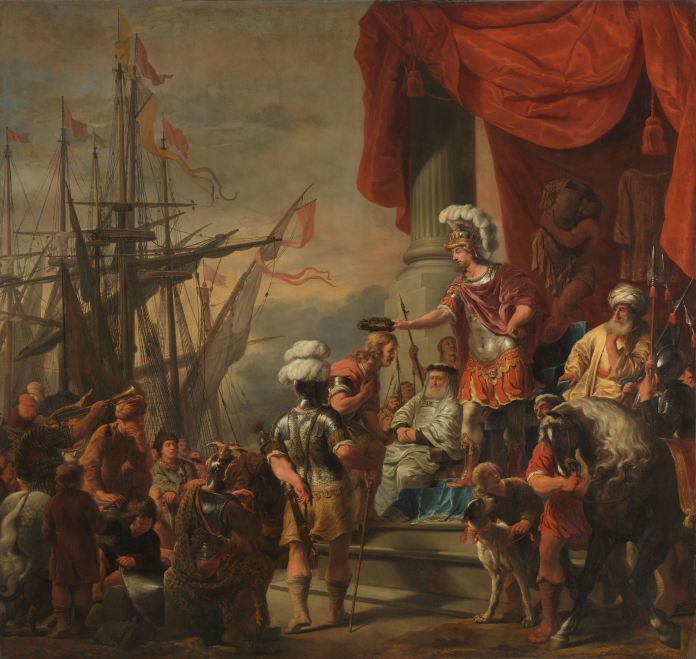
Aeneas Crowns Cloanthus, Painted by Ferdinand Bol (c. 1616-1680)

This painting, by the Dutch artist Ferdinand Bol (c. 1616-1680), re-creates a scene from the Aeneid, a poem by the Roman poet, Virgil (c. 70-19 BCE), that tells of the journey of the Trojan hero, Aeneas, as he travels west after the Trojan War. In the episode painted above, Aeneas had reached the island of Sicily, where he was well received by King Acestes, a ruler of myth or legend. Acestes helped the Trojan wanderers hold a massive set of funerary games in honor of Aeneas’ father, in which competitive events were held, such as racing and boxing. The first of the games was ship racing, where four of the greatest ships and the most talented crews competed for enticing prizes. Cloanthus won the event on his ship, the Scylla. Next came Mnestheus on the Dragon, then Gyas on the Chimaera, and finally Sergestus on the Centaur. Virgil poetically described Aeneas handing out prizes to the competitors of the race:

“The son of Anchises summons all together, true to custom.
A herald’s ringing voice declares Cloanthus the victor
and Aeneas crowns his brows with fresh green laurel.
He presents the prizes to each ship’s crew, some wine,
three bulls of their choice and a heavy silver bar
and for each ship’s captain lays on gifts of honor.
To the winner a cloak of braided gold that’s fringed
with thin ripples of Meliboean crimson running round it,
and woven into its weft, Ganymede, prince of woody Ida”
(Virgil, Aeneid, 5.273-281).

It is this scene of Aeneas rewarding the competitors of the ship race that inspired Ferdinand Bol’s painting. Masts and rigging of sailing vessels can be seen in the background of the artwork, and figures haul around the various gifts of animals, and objects that would be handed out that day. In the center of it all, Cloanthus is depicted receiving his laurel wreath from Aeneas.

Written by C. Keith Hansley


Sources:

The Bizarre Tale Of Thorolf Sledgehammer And His Army Of Magical Cats

A curious figure named Thorolf Sledgehammer can be found in a brief passage within the pages of the Vatnsdæla Saga, a text dated to the 13th or 14th century that tells the folkloric history of the first settlers who claimed land in the Vatnsdal region of Iceland. The saga purports to cover events that occurred between the years 875 and 1000. Thorolf Sledgehammer was said to have lived in the earlier years of that timeline, around the time when the first immigrants to Iceland were being succeeded by children who had been raised on the newly settled island. In Vatnsdal, the ascendant generation that was seizing power was a band of brothers named Thorstein, Jokul, Thorir, Hogni and Smid, who had succeeded their father, Ingimund—the first major chieftain of the Vatnsdal region. Thorolf Sledgehammer would ultimately clash with these brothers, resulting in a peculiar and outlandish showdown.

In the saga, Thorolf Sledgehammer is said to have been a mischievous, unruly and, ultimately, criminal individual. Yet, as medieval Icelandic criminals go, Thorolf’s record was relatively light, with accusations of theft making up the bulk of the legal complaints lodged against him. Besides these charges of thievery, Thorolf’s lifestyle seemed to unnerve his neighbors. As told by the saga, he had no relatives living in Vatnsdal at the time when he arrived in the region, and neither did he bring a family with him to his new home. Instead, he built an estate called Sleggjustadir on a piece of land that was dominated by mires and bogs, and mainly kept to himself, living there without any friends or servants. Although he was not one for human companionship, Thorolf did not technically live alone. Quite the opposite, his estate was reportedly a haven for a great number of cats—twenty of them, according to the saga. Due to Thorolf’s hermit-like nature and his general oddness, the people of Vatnsdal soon began to look askance at him, and suspicions arose that the reclusive cat-loving thief was somehow attuned to supernatural knowledge and power. The Vatnsdæla Saga embraced these rumors, portraying Thorolf Sledgehammer as a powerful sorcerer and wizard who was very capable in the ways of magic. His cats, too, were suspected of being supernatural, either innately or otherwise empowered through enchantments or spells.

As time went on, the already unsure relationship between Thorolf Sledgehammer and the rest of Vatnsdal only further deteriorated. Accusations of theft continued to accumulate and suspicions of nefarious magic deepened. Eventually, the community started to petition their leaders to do something about the strange man. Ultimately, the heads of the community did take an openly hostile stance against Thorolf, perhaps asking him to cooperate with investigations into theft, or to leave Vatnsdal altogether. The leaders of the community reportedly paid one peaceful visit to Sleggjustadir to present to Thorolf the complaints and wishes of the people of Vatnsdal. Thorolf, however, was said to have responded uncooperatively to the demands of the community leaders. Nevertheless, Vatnsdal’s leaders would not let the matter go. Instead, the leading brothers, Thorstein, Jokul, Thorir, Hogni and Smid, along with an armed band of eighteen men, tried to break their way into Thorolf’s house. This task, so the story goes, proved to be much more difficult than they might have imagined.

According to the saga, Thorolf Sledgehammer’s twenty loyal cats were more than a match for the posse of eighteen armed men that tried to occupy Sleggjustadir. The cats, described as “absolutely huge” and “much under the influence of witchcraft” (Vatnsdæla Saga, chapter 28), had been corralled by Thorolf into the estate’s main house before the raid was made on his property. Caterwauling, hissing and terrifyingly-fierce glares from these cats were apparently enough of a deterrent to keep the warriors of Vatnsdal from barging straight into the house. During the standstill, the armed militia outside shouted for the barricaded man to come out and face them. Thorolf refused, saying that he did not expect they would give him fair treatment.

With no surrender in sight, the Vatnsdal warriors decided to use a popular tactic prevalent in many sagas—arson. As the story goes, Thorolf’s house was set alight while he and his cats were still inside. With his home burning down around him, Thorolf Sledgehammer made up his mind to attempt an escape. Using the fiery environment to his own advantage, Thorolf began burning wool to further fill the house and the immediate surroundings with smoke. Then, under the cover of the smokescreen, Thorolf jumped out of an opening from his house, lugging small chests of treasure under each of his arms. His attempted escape, however, did not go overlooked by the Vatnsdal militia. One of the men from the posse caught up to Thorolf as he was trying to weave his way through the mires around his home. As the story goes, both the fleeing man and his pursuer fell into a deep section of the bog and drowned. Although Thorolf Sledgehammer did not survive, many of his faithful felines did manage to escape the fire. The anonymous author of the Vatnsdæla Saga claimed that wild cats still roamed around Sleggjustadir in his own time.

Written by C. Keith Hansley

Picture Attribution: (Illustration made for Njal’s Saga, artwork by Andreas Bloch (1860–1917), placed on top of 19th century illustration of personified cats, [Public Domain] via Creative Commons and The British Library).


Sources:

  • Saga of the People of Vatnsdal, translated by Andrew Wawn and edited by Örnólfur Thorsson, in The Sagas of Icelanders. Penguin Classics, 2001.

Samson Captured by the Philistines, by Giovanni Francesco Barbieri (c. 1591–1666)

This painting was finished in the year 1619 by the Italian artist, Giovanni Francesco Barbieri (aka Guercino, c. 1591–1666). As the piece was commissioned by Cardinal Giacomo Serra—the papal legate to Ferrara—it comes as no surprise that the subject matter of the painting follows a Biblical story. The figures on the canvas, curiously outfitted in late-medieval armor and dress, re-create a famous scene from the life of Samson, a legendary Israelite warrior whose story is featured in the biblical Book of Judges. He was a scourge to the so-called Philistines, a mysterious seafaring people that invaded and settled a section of the Palestine coast around the 12th century BC, becoming a serious threat to ancient Israel. While the Philistines had formidable weaponry and admirable military organization, the Israelites had legendary heroes. Wielding superhuman strength, Samson proved to be almost an indomitable foe for the Philistines. Yet, as the biblical story and the painting above divulge, there was an exploitable weakness to Samson’s strength—hair. If Samson’s long and braided locks were cut, then so would his strength also be shorn away. As the story goes, the Israelite warrior unwisely told this secret to a woman named Delilah, who then conveyed the secret to the Philistines and plotted with them to capture Samson. The Book of Judges described the story of what happened next:

“After putting him to sleep on her lap, she called for someone to shave off the seven braids of his hair, and so began to subdue him. And his strength left him. Then she called, “Samson, the Philistines are upon you!” He awoke from his sleep and thought, “I’ll go out as before and shake myself free.” But he did not know that the Lord had left him. Then the Philistines seized him, gouged out his eyes and took him down to Gaza” (Judges 16:19-21, NIV version).

Giovanni Francesco Barbieri loosely re-creates the scene, with the characters wearing 16th-or early 17th-century fashion. Samson is with his back turned to the audience, struggling to fight now that his hair and power were reduced. As mentioned in the quote, he did not get away from the ambush. Yet, Samson would have the last laugh. As his hair began to grow back, so did his strength. With a few prayers to supplement his recovering power, he was said to have summoned enough strength to demolish the Philistine temple where he was being kept, killing himself and many of his captors.

Written by C. Keith Hansley

Sources:

Chief Joseph

Chief Joseph
(Nez Percé/Nimiipuu leader, c. 1840-1904)

“Treat all men alike. Give them all the same law. Give them all an even chance to live and grow. All men were made by the same Great Spirit Chief. They are all brothers.”

  • Chief Joseph’s Own Story, by Chief Joseph, originally published in 1879; republished with an introduction by Bishop W. H. Hare and General Howard’s Comment in The North American Review (1879). Reprinted by Kessinger Publishing, 2010.

The Tale Of Chundo—A Man Sentenced To Trial By Combat And Stoning For Illegal Hunting

King Guntram of Burgundy (r. 561-593) and his entourage of guards and courtiers went on a hunting trip around the year 590 into the royal forests of the Vosges mountain range, in eastern France. While Guntram and his companions trekked around the royal forest, they came across evidence that an animal in the forest had been illegally killed by someone who was not the king or a member of his immediate hunting party. The slain creature was an aurochs—a large species of wild cattle that has since become extinct. Guntram called for an investigation into the unsanctioned killing of the aurochs and summoned the local forester who was responsible for the Vosges forests.  Precise information about the evidence collected in the investigation is unknown, but ultimately the list of suspects was narrowed down to someone close to King Guntram. According to the forester and the investigators he was aiding, the most likely culprit was a man named Chundo, who happened to be the royal chamberlain of the king.

What happened next was quite dramatic. King Guntram ordered a trial by combat to be arranged, with the defendant, Chundo, facing off against his main accuser, the forester. Due to inability, cowardice or scheming, Chundo decided not to personally participate in the fight. He could do this because the system of trial by combat allowed the chamberlain to choose a champion to duel on his behalf. Therefore, Chundo picked his nephew to represent him in the violent trial. As the young lad was fit and a decent fighter, perhaps Chundo believed it would be a favorable match-up for his case. Whatever the reasoning, out of fear or confidence, the chamberlain let his nephew enter a duel to the death. An account of the fight between Chundo’s nephew and the forester was recorded by Bishop Gregory of Tours (c. 539-594), who was well acquainted with King Guntram and his court:

“The King decided upon trial by combat. The Chamberlain appointed a nephew of his to do battle in his stead. When the two stood face to face on the battlefield, the young man hurled his spear at the forester and pierced his foot, so that he fell over backwards. Then he drew the dagger which hung at his belt and tried to cut the fallen man’s throat. Instead he himself was wounded in the stomach by a knife-thrust. In short they were both laid low and died” (Gregory of Tours, History of the Franks, X.10).

Such was the way the duel turned out. The chamberlain’s nephew had a valiant start, but he made fatal mistakes as he was trying to finish off his opponent. The young man eventually did end the life of his foe, the forester, but not before suffering a death-blow to his own body. With both combatants dead, it was left to King Guntram to announce his interpretation of who won the duel and trial. Chundo, predicting that the king would rule in the forester’s favor, took off running before King Guntram could announce a decision on the trial. Guntram, however, was a king who usually had plentiful numbers of guards around himself, and these warriors were able to keep the chamberlain from escaping. Consequently for Chundo, his attempted flight only hardened the king’s opinion about the illegal hunting case and the trial. Guntram sentenced the chamberlain to death and the order was quickly executed. As told by Gregory of Tours, “[Chundo] was tied to a stake and stoned to death” (Gregory of Tours, History of the Franks, X.10). So ends the peculiar tale of Chundo, his nephew, and the forester of the Vosges. Curiously, King Guntram (who was posthumously considered a saint) later was said to have regretted that three people met such violent ends as a result of an illegal hunting incident in his royal forest.

Written by C. Keith Hansley

Picture Attribution: (Hunting scene from a fresco transferred to canvas, dated to the 12th century in Castile-León, Spain, [Public Domain] via Creative Commons and the MET.jpg).


Sources:

The Sacrifice of Polyxena at the Tomb of Achilles, painted by Giovanni Battista Pittoni the Younger (c. 1687-1767)

This painting, created by the Italian artist Giovanni Battista Pittoni the Younger (c. 1687-1767), was inspired by the tragic myth of Polyxena, a Trojan princess captured by the Greeks at the end of the mythical or legendary Trojan War. Polyxena was the daughter of King Priam and Queen Hecuba of Troy, and the princess’ post-war fate seemed to be leading down the path of enslavement. She, her mother, and other women of Troy were dragged to the fleet of Greek ships, which would carry the captives to strange new homes across the Aegean. Yet, the weather was unfavorable for sailing, and the Greek fleet could not set out to sea. As told in Euripides’ tragedy, Hecuba (produced c. 424 BCE), and centuries later in the Metamorphoses of the Roman poet, Ovid (c. 43 BCE- 17 CE), the unyielding weather was said to have been caused by the ghost of Achilles, who was holding the Greeks hostage until they honored him with a sacrifice. Achilles’ ghostly demands were very specific—only the human sacrifice of Polyxena would appease him and end the winds. The Greeks agreed to their deceased friend’s terms and sent warriors to grab Polyxena, who was with the other captured women on the ships. Ovid skillfully narrated the scene:

“Torn from Hecuba’s arms—she was almost the only comfort
her mother had left—the ill-starred maiden displayed a courage
transcending a woman’s, as guards led her up to the hero’s mound
to be laid on his grave as a victim. Once in front of the fatal
alter, she realized the rite was intended for her,
but she never forgot who she was. When she saw Neoptólemus waiting,
sword in hand, with his eyes intently fixed on her own,
she said to him: ‘Take my noble blood and delay no longer.’”
(Ovid, Metamorphoses, 13.449-457)

This description of Polyxena being led to the tomb of Achilles for sacrifice is what Giovanni Battista Pittoni the Younger re-created in the painting above. According to both versions of the myth, Euripides’ earlier Greek edition and Ovid’s later Roman account, Polyxena greatly impressed the Greeks with her courage in the face of death, for she did not struggle and there was no need for her to be restrained. In depicting the Trojan princess, Giovanni Battista Pittoni seems to follow Ovid’s description, for in the Metamorphoses and in the painting Polyxena “preserved her maidenly virtue, arranging her garments to cover the parts men’s eyes should not see” (Metamorphoses, 13.479-480), whereas Euripides claimed that Polyxena “took her robe and tore it open from the shoulder to the waist, displaying a breast and bosom fair as a statue’s” (Euripides, Hecuba, approximately line 560).

Written by C. Keith Hansley


Sources:

Queen Faileuba’s Destruction Of The Servant, Septimima

Members of the Frankish Merovingian Dynasty, especially in their heyday of the 5th, 6th, and early 7th centuries, were known to be a ruthless bunch, infamous for their bloodthirsty family intrigue and civil wars. Battles between father, son or brother; murders of spouses, assassinations of children, and having one’s own aunt dragged to her death behind a horse—almost any crime that can be imagined was done or attempted by the Merovingians. And it was not just the kings of the dynasty who overindulged on bloodshed. The queens who married into the family often proved just as ruthless and cold-blooded as their husbands. Of these powerful women, the most famous are Queen Fredegund (flourished c. 568-596/597) and Queen Brunhild (c. 534-613), who both became matriarchs of rival branches of the Merovingian Dynasty. Although there are plenty of stories concerning these two influential and competent women, a third queen will take the leading role in the particular tale told here. This story concerns Queen Faileuba, the wife of Brunhild’s son, King Childebert II (r. 575-595).

Although Merovingian queens or consorts could gain great power and influence, their positions were also quite unstable. The longevity of a queen’s power often boiled down to how much chemistry she had with the king, and how many kingly heirs she bore for the furtherance of the dynasty. Not all women could match the moods and expectations of the kings, so the position of queen and consort in the courts of the Merovingian kingdoms was an insecure role. Most of King Childebert’s kinsmen, for example, each married between three to five different queens in their lifetimes, not to mention the other concubines in their courts who were never elevated to the position of consort. Queen Faileuba was well aware of the prolific matrimonial pattern of the Merovingian kings, and therefore she was naturally under a great deal of stress, anxiety and fear until she could establish herself firmly as the mother of King Childebert’s heirs.

Faileuba gave birth to her first child with King Childebert in 587—it was a boy and they named him Theodoric (or Theoderic) II. Although producing a potential heir must have been a great relief to the queen, she still had a major problem. Faileuba’s newborn child, Theodoric, was not the king’s oldest son. In fact, only one year earlier, in 586, a mysterious concubine had borne King Childebert a son named Theodebert II. The name of this shadowy concubine is unfortunately unknown, perhaps as a result of fierce smear campaigns that would later be waged by the supporters of Faileuba’s son, Theodoric, who insinuated that the older sibling, Theodebert, had no royal blood. Despite these later politics, King Childebert II recognized both of the boys as his children and heirs. Therefore, Faileuba had to keep a wary eye on her stepson, as well as on other women who might catch the eye of the king.

Queen Faileuba became pregnant, once again, around 589. The child was delivered successfully, and perhaps this second birth made the queen feel more self-sure and confident in her position as a dominant and entrenched regal figure. These secure feelings, unfortunately, plummeted into despair when queen Faileuba watched her newborn child sicken and die within a couple of days after birth. In her wearisome mix of heartbreak, grief, and a renewed sense of insecurity, Queen Faileuba began to feel paranoid about other members of the court. As the queen rested from the recent childbirth and grieved over her lost child, she became suspicious about various members of the palace staff, as well as certain nobles and officials who frequented the palace. Rightly or wrongly, well-founded or unfounded, the motives of what the emotionally-compromised queen did next are difficult to ascertain. Whatever the case, Queen Faileuba emerged from her period of recovery and mourning with a peculiar list of people that she said were conspiring against herself, the king, and the king’s mother. Faileuba claimed that the ringleader of this supposed conspiracy was a certain woman by the name of Septimima, who was a nurse to King Childebert’s children. Whether or not Septimima was truly conspiring against the crown or simply a romantic rival to Faileuba is unknown, but when the insinuation was brought to the ears of Faileuba’s mother-in-law, Brunhild, the older matriarch likely flexed her skills at intrigue and political maneuvering to seize upon the opportunity to reorganize certain positions in the palace to better fit her liking. Soon, names such as Droctulf (a tutor to the royal children), Sunnegisil (the Count of the Stables), and Gallomagnus (a referendary) were added to the list of conspirators.

Queens Faileuba and Brunhild brought their list to King Childebert, accusing Septimima, Droctulf, Sunnegisil and Gallomagnus of various crimes. In particular, the conspirators allegedly wanted Brunnhild to be exiled and similarly hoped to have Faileuba dismissed as queen. The listed individuals then planned to convince King Childebert to remarry, with Septimima perhaps being the new queen. If the king did not fall for Septimima’s charms, claimed Faileuba and Brunhild, the conspirators would then feel free to use their ultimate power—witchcraft. Queen Faileuba accused Septimima of being a witch and, the queen theorized, if the king had not gone along with the conspirators, he would allegedly have been struck down by the power of their nefarious magic. With the king out of the way, Septimima (as the nurse) and Droctulf (as the tutor) allegedly planned to lord over the king’s two sons as the powers behind the throne. Whether or not any of the allegations were true, King Childebert II decided to take the allegations seriously, and he hauled in the named individuals for interrogation.

Unfortunately, during much of the Middle Ages, interrogation was synonymous with torture, and that was true in Childebert’s kingdom. Septimima and Droctulf were quickly apprehended, as they worked at the palace, and were relentlessly plied with the latest instruments of pain. Under the affliction of torture, they began to confess to anything that was asked of them. At first, Septimima and Droctulf confessed to innocuous statements such as that they were having an affair together. The confessions quickly began to escalate, with them eventually pleading guilty under torture to witchcraft, conspiracy, treason, so on and so forth. As for the other named conspirators, Sunnegisil and Gallomagnus, these two had more time to evade Childebert’s law enforcers, and they managed to seek sanctuary in a church before they were discovered. This move saved Sunnegisil and Gallomagnus from being tortured—at least for the time being—and without the infliction of pain, they steadfastly denied being involved in any plot. King Childebert, however, out of disbelief or opportunism, chose not to take the two men at their word, and instead decided to seize all of the properties they possessed in the kingdom and sentenced them to exile.

A much worse fate was in store for Septimima and Droctulf, involving beatings, mutilation, and forced labor. A detailed description of the elaborate punishment was recorded by Bishop Gregory of Tours (c. 539-594), a contemporaneous figure to that time, and a man well acquainted with the Merovingian royals. On what happened to Septimima and Droctulf, Gregory wrote:

“Septimima and Droctulf were both severely beaten. Septimima’s face was disfigured with red-hot irons. All that she had was taken from her, and she was packed off to the country estate of Marlenheim to turn the mill and grind the corn each day to feed the women who worked in the spinning and weaving room there. They cut off Droctulf’s ears and hair, and he was sent to labour in the vineyards. A few days later he escaped. He was discovered by the bailiff and once more brought before the King. He was flogged and sent back again to the vineyard which he had left” (Gregory of Tours, History of the Franks, IX.38).

During the time that the king, his mother and his wife were meting out these punishments, Childebert’s powerful and influential uncle, King Guntram of Burgundy (r. 561-593), looked on at the scene in bewilderment and felt the need to have a small intervention. He could do nothing for the two who had already been mutilated, but he did send a party of envoys and bishops to Childebert’s court to ask the king to rescind the banishments of Sunnegisil and Gallomagnus. Childebert agreed to his uncle’s suggestion and allowed the two exiles to return home. Some, but not all, of their property was restored. Nevertheless, it was a mistake for the two men to go back. King Childebert II never trusted them, presumably because he truly thought they were conspirators or, more cynically, because he simply feared that they would now want revenge after their maltreatment. Little is known about how the rest of Gallomagnus’ life played out, but Sunnegisil was later known to have been arrested again, and on that occasion, he failed to reach the safety of a church and was not spared from the king’s relentless torturers.

Written by C. Keith Hansley

Picture Attribution: (Miniature of a queen with four women, from a manuscript of De Claris Mulieribus (labeled BL Royal 16 G V, f. 3v in The British Library), [Public Domain] via Creative Commons).


Sources:

  • The History of the Franks by Gregory of Tours, translated by Lewis Thorpe. New York: Penguin Classics, 1971.

Dictatorship Offered To Cincinnatus, Painted By Giovanni Battista Tiepolo (c. 1696–1770)

This painting, by the Italian artist Giovanni Battista Tiepolo (c. 1696–1770), re-creates a famous legend from the days of the early Roman Republic. The scene painted above is set in the year 458 BCE, when the Romans were facing a combined threat from Aequians and Sabines. Rome had deployed its military to take on the threats, but during the campaign, Consul Minucius and his Roman army became trapped and besieged by their enemies. Minucius’ situation was reportedly quite dire, throwing Rome into a panic. In the fear and anxiety, the Romans decided to appoint a dictator to quickly pull together an army to rescue Consul Minucius’ besieged forces. Lucius Quinctius Cincinnatus was the man they chose for the job, represented in Giovanni Battista Tiepolo’s painting as the man dressed in grey with the blue sash. As the legend goes, Cincinnatus was not present when the government nominated him as dictator. Therefore, messengers had to go to Cincinnatus’ farm to tell him of his powerful appointment. The famous scene was described by the Roman historian Livy (c. 59 BCE-17 CE):

“Cincinnatus, the one man in Rome who reposed all her hope of survival, was at that moment working a little three-acre farm (now known as the Quinctian meadows) west of the Tiber, just opposite the spot where the shipyards are today. A mission from the city found him at work on his land—digging a ditch, maybe, or ploughing. Greetings were exchanged, and he was asked—with a prayer for God’s blessing on himself and his country—to put on his toga and hear the Senate’s instructions. This naturally surprised him, and, asking if all were well, he told his wife Racilia to run to their cottage and fetch his toga. The toga was brought, and wiping the grimy sweat from his hands and face he put it on; at once the envoys from the city saluted him, with congratulations, as Dictator…” (Livy, History of Rome, 3.26).

Such is the scene that Giovanni Battista Tiepolo depicted in his painting. As Cincinnatus was a figure of legend, it comes as no surprise that he produced legendary results during his short term in office. As the story goes, he quickly trained the remaining manpower in Rome into an elite fighting force and marched off to rescue Consul Minucius’ pinned down army. After they reached their destination, Cincinnatus’ forces reportedly freed Minucius’ army by attacking the besiegers at night, winning victory by dawn. When the victorious Cincinnatus returned to Rome, he reportedly resigned from his powerful position as quickly as possible. According to the aforementioned historian Livy, Cincinnatus held the office of dictator for fifteen days in 458 BCE.

Written by C. Keith Hansley


Sources:

Sappho of Lesbos And The Husband Hoax

Sappho was a woman from the Greek island of Lesbos who prolifically composed songs and poems during the late 7th and early 6th centuries BCE. Her verses were greeted with great acclaim in ancient Greek and Roman circles, and she was considered to be rightfully ranked among the most talented poets to have ever lived in ancient Greece. In the 3rd and 2nd centuries BCE, enough of Sappho’s poems were still existent to fill nine volumes in the Library of Alexandria, possibly amounting to around 9,000 lines of poetry.  Time, however, has ravaged Sappho’s work—of the nine volumes of her poems known to the ancients, only around 230 poetic fragments have survived to the modern day. As much of the biographical details about Sappho comes from these fragments, so too is her history fragmentary in nature, with legend, folklore and guesswork filling in the gaps.

Although our view of Sappho’s life is obscured, we can still make out a vague picture of her lifestyle and family. We know she was from an aristocratic clan on Lesbos, and although her existent poems rarely touch on politics, the clan that she belonged to was indeed involved in intrigue (for which they were banished from the island from time to time). Her father has been given many names over the years, but Skamandrios seems to be one of the most popular. As for Sappho’s mother, her name is thought to have been Kleïs. Sappho was not an only child—she had brothers. Charaxus, Larichos, and Eriguios were their names, and the first seemed to be the worrisome troublemaker of the family, as Sappho chastised Charaxus with verses about his adventures and dalliances. As for Sappho, herself, she became a leader of a female entourage in Lesbos. The nature of this group has been much debated: from Platonic poetry lessons, to scandalous orgies, and everything in-between—it has all been suggested, and each interpreter points to a vague fragment to support their view. Whatever the case, Sappho was undoubtedly a mentor figure to young women in Lesbos, teaching them song, dance, poetry and wisdom. On the other side of the argument, however, Sappho’s fragments leave ample evidence that the poet was sexually attracted to her female companions. Both interpretations are not mutually exclusive, and as Sappho lived in ancient Greece, she would not have been the only figure to be both a mentor and a lover to ancient Greek students.

Although Sappho is best known for her attraction to women, tales were recorded about her that hinted a husband and child might have been in her history. This very well could be true—as a marriage might have been a part of her mysterious and unknown early adulthood—but the scant evidence leading to this conclusion is often deemed inconclusive. A fragment attributed to Sappho does mention the poet having some sort of guardian-like compassion for a girl named Kleïs. Sappho describes this girl with a word that can translate to ‘daughter,’ ‘child,’ or ‘slave.’ Whether this person was Sappho’s daughter, a student, or an enslaved servant, the poet claimed in a short poem that she adored her, and that the girl reminded her of a flower, and then the fragment ends. Such is the difficulty of piecing together a biography through vague fragments without context. As for Sappho’s supposed husband, only the 10th-century Suda Lexicon from the imperial city of Constantinople recorded a name, and the name it proposed is not very believable. According to the Suda, Sappho was married to a certain Kerkylas of Andros. Although this information is presented matter-of-factly by the medieval encyclopedia, it is almost unanimously considered to be a dirty joke. ‘Kerkylas’ was a Greek word filled with phallic connotations, and Andros, although a real island, also means ‘of man.’ Therefore, while Kerkylas of Andros sounds like a perfectly good name at first glance, it could also be translated into much more bawdy titles, such as Dick of Man. Understandably, few scholars are convinced that Kerkylas was the husband of the famous Lesbian poet, Sappho.

Written by C. Keith Hansley

Picture Attribution: (“Sappho and Alcaeus,” painted by Lawrence Alma-Tadema (1836–1912), [Public Domain] via Creative Commons and The Walters Art Museum).


Sources: