Home Blog Page 136

Alexander the Great At The Battle Of The Granicus Against The Persians, Painted By Cornelis Troost (c. 1697-1750)

This painting, created by the Dutch artist Cornelis Troost (c. 1697-1750), was inspired by the Battle of the Granicus, fought between Alexander the Great and the Persians in 334 BCE. It was the first major pitched battle that occurred after Alexander the Great crossed into Anatolia and invaded lands controlled by the Achaemenid Empire, then ruled by Darius III (r. 336-330). In choosing to engage the enemy at the Granicus River, Alexander the Great handicapped himself, for he would have to ford through the water in order to strike at his foes. If, however, he could beat the odds as well as the opposing army, it would add further to the renown and distinction gained from the victory. At the start of the battle, Alexander brought his army to the banks of the Granicus in battle array, with the Persians matching him on the other side. Alexander positioned himself with the troops on the right flank of his army, and he sent the other columns on his left to begin marching into the water of the river. Although Alexander had other columns advance first, it was his own cavalry force positioned on the right side that would be the real threat to the Persians. While the opposing army was distracted by the marching infantry, Alexander the Great charged across the river with his cavalry from the side and, as he often did, began fighting his way straight for the Persian commanders. The Roman historian, Arrian (90-173+), described this cavalry charge:

“The first to engage the Persians were cut down and died a soldier’s death, though some of the leading troops fell back upon Alexander, who was now on his way across: indeed, he was almost over, at the head of the army’s right wing. A moment later he was in the thick of it, charging at the head of his men straight for the spot where the Persian commanders stood and the serried ranks of the enemy horse were thickest. Round him a violent struggle developed, while all the time, company by company, the Macedonians were making their way over the river, more easily now than before” (Arrian, Anabasis, 1.15).

Such is the spirit of the scene that Cornelis Troost endeavored to re-create in his painting. On the left side, the first waves of troops that crossed the river can be seen in the heat of battle. Alexander is shown in the center of the painting, joining the battle by the riverbank. In the background of the right side of the artwork, more forces can be seen wading through the water toward the scene of battle. Alexander, of course, went on to win the Battle of the Granicus in 334 BCE. Over the next years, the Achaemenid Empire would be dismantled by further battles and conquests carried out by Alexander the Great.

Written by C. Keith Hansley


Sources:

  • The Campaigns of Alexander by Arrian, translated by Aubrey de Sélincourt. New York: Penguin Classics, 1971.
  • Alexander the Great by Philip Freeman. New York: Simon & Schuster Paperbacks, 2011.
  • Alexander the Great: The Story of an Ancient Life by Thomas R. Martin and Christopher W. Blackwell. New York: Cambridge University Press, 2012.

The Raucous First Meeting Between Chief Joseph And General Howard

Chief Joseph—also known as Young Joseph, Hin-mah-too-yah-lat-kekt (Thunder Rolling Down the Mountain), In-mut-too-yah-lat-lat (Thunder-traveling-over-the-mountains) and sometimes spelled Hinmatóowyalahtq’it—was a Nimiipuu (or Nez Percé) leader who commanded a band of followers in the Wallowa Valley of northeast Oregon. Chief Joseph’s father, Joseph the Elder, had worked with many other Nimiipuu chiefs to negotiate a treaty with the United States in 1855, which reserved around 7.5 million acres of land in the Idaho and Oregon region for the Nimiipuu people. In 1863, however, the United States began a new treaty negotiation that would leave Nimiipuu chiefs like Joseph the Elder and his son, Young Joseph, feeling betrayed.

Driven by a lust for gold and land, the United States’ new treaty in 1863 reduced the earlier sprawling 7.5-million-acre reservation to only around 750,000 acres in Idaho. This greatly-reduced reservation was further divvied up to U.S. settlement by the Allotment Act, which opened up certain parcels of land in the reservation region to non-Nimiipuu settlement. Joseph the Elder, whose land was not in the reservation, rejected the new treaty, and when Young Joseph took over leadership of the Wallowa Valley band in 1871, he staunchly continued his father’s policy of resisting the 1863 treaty. The United States briefly and temporarily considered allowing Chief Joseph and his people to stay in the Wallowa Valley, going so far as to ban settlers from entering Chief Joseph’s land in 1873, but the US quickly reversed its decision and allowed settlement of the Wallowa Valley region to resume before the year 1873 was over. From then on, the United States ramped up the pressure on Chief Joseph and other dissident Nimiipuu leaders, demanding that they relocate their people to the reservation in Idaho. By 1877, the United States had run out of patience, and the earlier urgings now turned into ultimatums. General Oliver Otis Howard was sent to inform Chief Joseph and other Nimiipuu leaders outside of the reservation that it was time to move or be moved.

General Howard and the non-reservation Nimiipuu chiefs met for a multi-day negotiation in early May, 1877. It was a tense meeting with a great deal of posturing on both sides. Chief Joseph and General Howard both wrote accounts of this negotiation, each accusing the other side of behaving in a threatening and obstinate manner. Chief Joseph’s complaints were mainly against the conduct of the general, portraying him as a haughty and self-righteous individual. Gen. Howard, on the other hand, accused the chiefs of not respecting the power and authority of the United States, and of otherwise being intimidatory before and during the negotiations. The general, however, was not there to negotiate, per se, but instead to explain, answer questions, and prepare a schedule for the future—he already had his orders to move Chief Joseph and the other chiefs to their reservation by any means necessary. Instead of a new treaty, this was to be an eviction notice.

Chief Joseph and General Howard began their accounts of the meeting differently, the chief immediately describing the speeches and dialogue, whereas the general began with the arrival of the Nimiipuu chiefs at the meeting location. It is a shame that Chief Joseph did not describe the manner in which he appeared at the negotiation site, for the general colorfully described the scene as a hostile act of intimidation, with Chief Joseph and his colleagues circling around the Americans, singing and chanting while armed with tomahawks. General Howard described the scene as follows:

“These picturesque people came in sight, after keeping us waiting long enough for effect. They drew near the hollow square of the post and in sight of us, the small company to be interviewed. They struck up their song. They were not armed except with a few ‘tomahawk-pipes’ that could be smoked with the peaceful tobacco or penetrate the skull-bone of an enemy, at the will of the holder…The Indians sweep around the fence and make the entire circuit, still keeping up the song as they ride, the buildings breaking the refrain into irregular bubblings of sound till the ceremony was completed” (General Howard’s Comment On Joseph’s Narrative, approximately paragraph 26).

Next, once the meeting began, it was General Howard’s turn to start misbehaving. From Chief Joseph’s perspective, the general barraged the Nimiipuu chiefs with such impudent statements as “You deny my authority, do you? You want to dictate to me, do you?” and “law says you shall go upon the reservation to live, and I want you to do so, but you persist in disobeying the law…If you do not move I will take the matter into my own hand and make you suffer for your disobedience” (Chief Joseph’s Own Story, paragraphs 27 and 29). General Howard, for his part, denied that he behaved rudely or arrogantly, yet his phrasing that he strove “to behave as a gentleman to the weakest or most ignorant human being” (General Howard’s Comment, approximately paragraph 33) makes one wonder about how his tone might have sounded during the negotiations. General Howard added further corroboration to Chief Joseph’s interpretation of the meeting when the general admitted to stating curious lines such as, “I stand here for the President, and there is no spirit, good or bad, that will hinder me. My orders are plain and will be executed. I hoped that the Indians had good sense enough to make me their friend and not their enemy” (General Howard’s Comment, approximately paragraph 44).

One of the tensest moments of the multi-day meeting was an exchange between General Howard and Chief Toohoolhoolzote—an outspoken Nimiipuu leader who was as zealous and self-sure as the US general. Of all the Nimiipuu chiefs who attended the meeting, General Howard considered Toohoolhoolzote to be the most troublesome. Gen. Howard described listening to the forceful oratory of this fellow, writing, “I heard him patiently, for quite a length of time, asserting his independence and uttering rebellious speeches against the Washington authority” (General Howard’s Comment, approximately paragraph 44). The chief’s impassioned defenses of the Nimiipuu people’s claim to the land and his vociferous criticism of the United States’ uninvited encroachments into the tribe’s territory ultimately led to Toohoolhoolzote being arrested and detained by General Howard in the middle of the meeting. This event was mentioned in both accounts. Chief Joseph claimed that it was an arrest made out of anger, with General Howard telling Toohoolhoolzote, “You are an impudent fellow, and I will put you in the guard-house” (Chief Joseph’s Own Story, paragraphs 31). The general, on the other hand, proposed that the arrest was a calculated move, and in no way done out of a lost temper. Instead, General Howard argued, “From various unmistakable signs (I am no novice with Indians) I saw that immediate trouble was at hand. Joseph, White Bird, and Looking Glass indorsed and encouraged this malcontent. I must somehow put a wedge between them” (General Howard’s Comment, approximately paragraph 44). The wedge he concocted was to forcibly detain Toohoolhoolzote away from the other Nimiipuu chiefs for several days. While he remained under arrest, the rest of the group were escorted to the reservation to inspect potential spots for their new homes. Toohoolhoolzote was released when the other chiefs returned from their tour.

At the conclusion of the meeting, General Howard gave the Nimiipuu chiefs an ultimatum that if they had not moved in 30-35 days, then he would send in the troops to remove them. Chief Joseph wrote down his recollection of the comment: “General Howard replied, ‘If you let the time run over one day, the soldiers will be there to drive you on to the reservation, and all your cattle and horses outside of the reservation will fall into the hands of the white men” (Chief Joseph’s Own Story, paragraphs 38). General Howard, in his response, admitted to having his soldiers on standby to occupy Wallowa Valley, and he made no defense against Chief Joseph’s claims of potential livestock loss; the general only felt the need to comment that none of the Nimiipuu chiefs raised any objection to his 30-35 day time period.

As a meeting meant to bridge divides and ensure a peaceful resolution to a complicated situation, this peculiar gathering at the beginning of May, 1877, in no way fulfilled its mission. Instead, General Howard left exasperated with the dissident Nimiipuu chiefs, whereas Chief Joseph and his comrades were pushed even further into a corner, faced with making the weighty choice between relocation or war. Yet, it was not only the decision-making chiefs who were influenced by the anger of the moment. The Nez Percé War that would soon emerge was not brought on by Chief Joseph and his fellow chiefs, but by a rogue group of Nimiipuu warriors who attacked United States settlers while the chiefs were reportedly still debating what to do next.

Written by C. Keith Hansley

Picture Attribution: (Left side: Photograph of Chief Joseph in 1879 (digitized by the MET). Right side: Photograph of Oliver Otis Howard in 1864 (digitized by the Smithsonian Institute), both photographs are [Public Domain] via Creative Commons).


Sources:

King Numa Pompilius, Painted By Merry-Joseph Blondel (c. 1781–1853)

In this painting, the French artist Merry-Joseph Blondel (c. 1781–1853) envisions the mythical or legendary King Numa Pompilius of Rome, traditionally dated to have ruled between 716 and 674 BCE. Numa, according to Roman folklore, was the second king of Rome—successor to the city’s mythical founder and first king, Romulus. As opposed to Romulus’ violent and war-torn reign, Numa was said to have been a more peaceful ruler, whose specialties were in religion, law, and the general pursuit of wisdom. On this aspect of Numa’s character, the Roman historian Livy (59 BCE-17 CE) wrote, “Numa Pompilius had a great reputation at this time for justice and piety. He lived in the Sabine town of Cures, and was, by the standards of antiquity, deeply learned in all the laws of God and man” (The History of Rome, 1.18). His natural wisdom was said to have been further amplified by a goddess named Egeria, who became his consort and counselor. In keeping with this wiseman persona, many ancient Roman religious and legal institutions and innovations were attributed to the king. This amalgamation of a divinely-connected priest, lawman, and wiseman, is what Merry-Joseph Blondel attempts to capture in his painting.

Written by C. Keith Hansley


Sources:

Diodorus Siculus’ Tale Of Brutal Punishments For People Who Killed Their Parents In Ancient Egypt

Studying the laws of ancient Egypt is a complicated task. The king or pharaoh was the top judicial figure in ancient Egyptian law, and as the new monarchs came to the throne, and as new dynasties rose and fell, so too could the laws and procedures of Egypt shift and change. The lack of existent formal legal codes from Ancient Egypt also hampers the efforts of Egyptologists and historians to understand ancient Egyptian law. As it is, researchers have to make do with resources such as archaeological information, records of individual ancient Egyptian court cases, and dubious accounts of foreign ancient historians (like Herodotus and Diodorus Siculus), whose information and interpretations could be hit or miss in accuracy. One such piece of legal information provided by Diodorus Siculus (c. 1st century BCE) involved the punishment faced by a person who killed his or her parents. Citing knowledgeable priests in Egypt, Diodorus Siculus claimed that the following was the punishment for someone guilty of patricide:

“For children who had killed their parents they reserved an extraordinary punishment; for it was required that those found guilty of this crime should have pieces of flesh about the size of a finger cut out of their bodies with sharp reeds and then be put on a bed of thorns and burned alive; for they held that to take by violence the life of those who had given them life was the greatest crime possible to man” (Diodorus Siculus, Library of History, I.77.8).

Such was the elaborate punishment that Diodorus Siculus and his informants believed was once meted out on murderers who killed their parents. Unfortunately, further details one might ask about the situation were excluded from the historian’s account. Questions such as how long this punishment was in use, and what was the specific criteria for being sentenced to or excluded from this execution, were left unanswered in Diodorus Siculus’ account.

Written by C. Keith Hansley

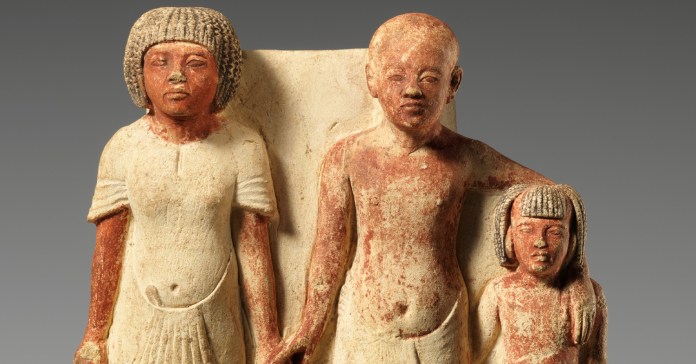
Picture Attribution: (Ancient Egyptian Statue dated ca. 1353–1336 B.C., [Public Domain] via Creative Commons and The Metropolitan Museum of Art).


Sources:

Illustration of Fredegund and Rigunth, from Henriette Guizot de Witt’s Vieilles Histoires de La Patrie

This illustration, from Henriette Guizot de Witt’s Vieilles Histoires de La Patrie (released in 1887), re-creates one of the most famous scenes from the 6th-century dysfunctional mother-daughter relationship between Queen Fredegund and her daughter, Rigunth. Fredegund is the assailant in this scene, pressing down on the lid of the chest, and Riguth is the unfortunate one caught in the ornate vise. The relationship between the two had not always been so bad—when an engagement between Rigunth and the Visigoth prince (and future king) Reccared was finalized in the year 584, Rigunth was said to have lovingly kissed her parents good-by before heading off toward the Spanish border with a large dowry. Alas, Rigunth’s father (King Chilperic) was assassinated later that year, causing the girl’s bright future to implode. Her marriage to Reccared was canceled just as she was reaching the borderlands, her dowry was stolen, and her guards and servants abandoned her in a rebellion-riddled land. The now-widowed Queen Fredegund had to send agents to whisk the despoiled princess to safety, but mother and daughter would seemingly never be a cheery family again. Assassinated loved-ones, smashed dreams, and the unstable fortune of their royal family placed both women on edge and made them moody and angry. These were dangerous qualities, especially in Queen Fredegund, as there was a ruthless and brutal side to her personality. Gregory of Tours (c. 539-594), a contemporaneous bishop to that time, described how the relationship between Fredegund and Rigunth spiraled out of control:

“She [Rigunth] would always insult her mother to her face, and they frequently exchanged slaps and punches. ‘Why do you hate me so, daughter?’ Fredegund asked her one day. ‘You can take all of your father’s things which are still in my possession, and do what you like with them.’ She led the way into a strong-room and opened a chest which was full of jewels and precious ornaments. For a long time she kept taking out one thing after another, and handing them to her daughter, who stood beside her. Then she suddenly said: ‘I’m tired of doing this. Put your own hand in and take whatever you find.’ Rigunth was stretching her arm into the chest to take out some more things, when her mother suddenly seized the lid and slammed it down on her neck. She leant on it with all her might and the edge of the chest pressed so hard against the girl’s throat that her eyes were soon standing out of her head. One of the servant girls who was in the room screamed at the top of her voice” (Gregory of Tours, History of the Franks, IX.34).

Such is the scene that is playing out in the illustration above. It shows Queen Fredegund thrashing the lid of the chest against her daughter’s neck in a moment of rage. The servant girl who screamed for help can be seen in the background of the artwork, frantically calling through the opened door. Fortunately for Rigunth, servants and guards rushed into the room to pull Fredegund away from her shocked daughter. As can be expected, this peculiar incident only caused the relationship between mother and daughter to worsen.

Written by C. Keith Hansley


Sources:

  • The History of the Franks by Gregory of Tours, translated by Lewis Thorpe. New York: Penguin Classics, 1971.

Sigurd the Volsung (from the Lay of Fafnir)

Sigurd the Volsung (figure from Norse and Germanic legend)

“Courage is better than the power of a sword,
where angry men have to fight;
for I’ve seen a brave man, fighting strongly,
conquer with a blunt sword.”

  • This quote comes from stanza 30 of the Lay of Fafnir, an old poem which was preserved in the 13th-century Poetic Edda, which was produced anonymously in Iceland. The translation is by Carolyne Larrington (Oxford University Press, 2014).

The Scandalous Death Of Duke Amalo

In 588, King Childebert II of Austrasia (r. 575-595) sent Bishop Gregory of Tours to the city of Chalon-sur-Saône as an envoy to Childebert’s uncle, King Guntram of Burgundy (r. 561-593). The bishop was tasked with bringing up several topics with Guntram. For one, Childebert wanted his respected uncle’s advice and consent for a plan to arrange a marriage for his sister with King Recared of the Visigoths (r. 586-601). Guntram was also asked if he wanted to participate in a military campaign that Childebert was planning to launch against the Lombards in Italy—a request that Guntram denied—and, on the more peaceful spectrum of government, they discussed the possibility of convening a council of French bishops from the two kingdoms. Although the talks and banquets that occurred between King Guntram and Bishop Gregory at Chalon-sur-Saône were interesting in themselves, perhaps the most intriguing event that occurred during that time was the arrival of a beaten and blood-splattered woman with a remarkable story to tell who sought sanctuary in the city. She was brought to the king in the church of Saint Marcellus, and there she told the gathering of the horrible experience she had undergone.

The woman—left unnamed by our source, Gregory of Tours—lived about 35 miles away from Chalon-sur-Saône, near an estate owned by a certain Duke Amalo. Her occupation and status in the community is vague, as Bishop Gregory only described her as “a young girl of free birth” (History of the Franks, IX.27). She was reportedly a great beauty, and her comeliness attracted the eye of Duke Amalo. The duke suppressed his interest, however, as he was a married man, brooding over his attraction in silence. Yet, one day in 588, when Amalo’s wife left town on a multi-day errand, temptation began to get the better of the duke. He tried to drown his emotions in alcohol, drinking deep into the night, but his drunkenness only increased the intensity of his cravings.

Drunkenness and unchecked power combined dangerously that night at the duke’s estate. Amalo, inflamed by passion, uninhibited by drink, and given opportunity because of the absence of his wife, decided that night in his drunken state that it was time for him to seize what he wanted. Duke Amalo sent loyal servants and warriors to seize the woman. Amalo’s henchmen raided her home and arrested the woman, dragging her toward the duke’s estate. As she was forcibly ushered toward the nobleman’s abode, however, she began to suspect the ill intent of the whole clandestine operation. She began to fight back, but she was overpowered by the duke’s servants and was successfully dragged into Amalo’s home. The duke, still incredibly drunk, stumbled over to greet his unhappy guest. Yet, when the henchmen released their grip on the women, she renewed her fight and a brawl ensued, with her receiving the worst of it. Amalo, according to Gregory of Tours, joined the fight, writing, “In his turn he, too, punched her and hit her and slapped her; then he took her in his arms” (History of the Franks, IX.27). Although the odds were against her, the woman would have the last laugh. Drunken Duke Amalo had been wearing a sword as the shameful incident was occurring. Noticing the weapon, the battered woman seized it and stabbed the duke to death with his own sword. As the servants of the estate stood in shock over the body of the dead duke, the woman wasted no time to make her escape. She fled and did not stop in her flight until she reached Chalon-sur-Saône.

All of this she told King Guntram, and perhaps Bishop Gregory was also present for her speech. As the story goes, the king believed her and fully took her side in the dispute. She was pardoned and protected from any retribution or litigation that could have come from the killing of a nobleman. Gregory of Tours described the scene of the victim telling her story and of the king’s response, writing, “She went into the church of Saint Marcellus, threw herself at the King’s feet and told him all that had occurred. He was filled with compassion. Not only did he grant her her life, but he ordered a royal edict to be drawn up to the effect that she was under his protection and must not be molested by any of the dead man’s relations” (History of the Franks, IX.27). The king’s edict was followed, and, as far as Gregory of Tours knew, the unnamed woman lived happily ever after.

Written by C. Keith Hansley

Picture Attribution: (Judith, from a 14th-century manuscript in the National Library of the Netherlands, [Public Domain] via Creative Commons).


Sources:

  • The History of the Franks by Gregory of Tours, translated by Lewis Thorpe. New York: Penguin Classics, 1971.

Death Of Charlemagne, Illustrated In A 14th-Century Manuscript Of The Chroniques De France Ou De St Denis

This illustration, from a 14th-century manuscript of The Chroniques de France ou de St Denis, depicts the death of Charlemagne (r. 768-814) and the subsequent spread of the news that the famous king and emperor was dead. Charlemagne had known that he was dying and therefore made moves to ensure a smooth transition. Einhard (c. 770-840), Charlemagne’s friend and biographer, wrote:

“At the very end of his life when he was worn down by ill-health and old age, he summoned his son Louis, King of Aquitaine, the only one of his sons by Hildegard to survive, and gathered together all the chief men of the whole kingdom of the Franks in a solemn assembly. He appointed Louis, with their unanimous consent, to rule with himself over the whole kingdom and made him heir to the imperial name” (Einhard, Life of Charlemagne, chapter 30).

Although Charlemagne’s court acknowledged that their liege’s death might occur in the foreseeable future, they were still caught off guard when the day that they feared actually arrived. Charlemagne fell ill and quickly died at Aachen in November, 814. It was sudden enough that Charlemagne’s son and heir, Louis “the Pious”, was not present for the final moments and had to be informed by messengers. These events were noted in the Royal Frankish Annals, which stated, “While spending the winter at Aachen, the Lord Emperor Charles departed this life on January 28, in about his seventy-first year, in the forty-seventh year of his reign…A large number of messengers informed Louis of this event at the royal villa of Doué in Aquitaine, where he was then spending the winter” (Royal Frankish Annals, entry for 814). The illustration above re-creates this scene. Charlemagne is shown on his deathbed at the left side of the artwork, and orange-robed messengers spread the news to bishops and kings. One of the kings being informed, obviously, is Louis the Pious. The identity of the other king, however, is more vague. He might be King Bernard of Italy (r. 813-818)—a nephew of Louis the Pious who would try (and fail) to rebel against the emperor in 817.

Written by C. Keith Hansley


Sources:

The Costly Divine Message Given To Chaerephon

Chaerephon was a childhood friend and loyal supporter of Athens’ great philosophical inquirer, Socrates. During the political chaos in Athens after the Peloponnesian War (c. 431-404 BCE), Chaerephon was banished from Athens by an oligarchical group, known as The Thirty. While in exile, Chaerephon paid a visit to the oracle of Apollo in Delphi, where he asked for the god’s response to an interesting inquiry. Instead of asking about his own fate, or that of Athens and Greece, he instead wanted the oracle to rank his friend, Socrates, against other prominent figures in the known world at that time. Two of Socrates’ protégés, Plato (c. 427-347 BCE) and Xenophon (c. 420-350 BCE), recorded versions of Chaerephon’s question and the answer he received. Plato quoted a speech that was reportedly delivered by Socrates: “You know Chaerephon. He was my friend from youth, and the friend of most of you as he shared your exile and your return. You surely know the kind of man he was, how impulsive in any course of action. He went to Delphi at one time and ventured to ask the oracle…if any man was wiser than I, and the Pythian replied that no one was wiser” (Plato, Apology, 21a). In Xenophon’s version, the oracle at Delphi appraised Socrates in more ways than just wisdom. Like Plato, Xenophon also wrote his account as if Socrates was the narrator, speaking, “Once on a time when Chaerephon made inquiry at the Delphic oracle concerning me, in the presence of many people Apollo answered that no man was more free than I, or more just, or more prudent” (Apology of Socrates, section 15). Socrates—always one who wanted to get to the truth of matters—was said to have been skeptical of these messages from Delphi, and he decided to investigate for himself if he were truly the wisest, most just, and most prudent man alive.

Years later, when Socrates was put on trial at Athens in 399 BCE for having atheistic or heretical beliefs, he brought up this message from Delphi during his defense speech, citing it, for one, as an example of him not being an atheist, and, two, designating Delphi’s message as the start of his downfall in public opinion. As Plato explained it, Socrates believed himself to not be particularly wise, and he thought his strength, contrastingly, was that he was not ignorant about his lack of wisdom. Therefore, as the story goes, Socrates took the message from Delphi to be a divine order for him to challenge the so-called wisemen of the world and show them that their wisdom was still lacking. Plato purported to quote Socrates talking about this: “So even now I continue this investigation as the god bade me—and I go around seeking out anyone, citizen or stranger, whom I think wise. Then if I do not think he is, I come to the assistance of the god and show him that he is not wise” (Plato, Apology, 23b). Dutifully following this mission, Socrates publicly questioned and discredited famous politicians, poets and craftsmen, a habit that angered the recipients of Socrates’ inquiries, as well as their supporters. Socrates had long been a controversial figure—the playwright, Aristophanes, had portrayed him as a troublemaker and a bad influence as far back as 423 BCE—but perhaps the message from Delphi caused Socrates to increase the frequency and ferocity of his clashes with self-proclaimed wisemen. Whatever the case, by 399 BCE, the powers that be in Athens had lost their patience with the seventy-year-old philosopher, and they sentenced him to death. Socrates famously refused to flee from his punishment, and willingly accepted the decision of the state.

Written by C. Keith Hansley

Picture Attribution: (19th-century scene of Socrates in ink and chalk, created by an anonymous artist, [Public Domain] via Creative Commons and The Metropolitan Museum of Art).


Sources:

The Dream Of Aeneas, Painted By Salvator Rosa (c. 1615–1673)

This painting, by the Italian artist Salvator Rosa (c. 1615–1673), re-creates a scene from The Aeneid—an epic poem by the Roman poet Virgil (c. 70-19 BCE) that narrates the journey of the Trojan refugee, Aeneas, from Troy to his new homeland in Italy. In this scene, the worn and weary Aeneas is visited by Tiber, the divine personification of the river on which the city of Rome would one day be built. Virgil described this scene in book eight of his poem:

“The dead of night.
Over the earth all weary living things, all birds and flocks
were fast asleep when captain Aeneas, his heart racked
by the threat of war, lay down on a bank beneath
the chilly arc of the sky and at long last
indulged his limbs in sleep. Before his eyes
the god of the lovely river, old Tiber himself,
seemed to rise from among the poplar leaves,
gowned in his blue-grey linen fine as mist
with a shady crown of reeds to wreath his hair,
and greeted Aeneas to ease him of his anguish”
(Virgil, The Aeneid, Book 8, approximately lines 27-36)

It is a scene of fate and prophecy that Virgil wrote. Rome was destined to one day be built along Tiber’s river, and, according to legend, it would be the descendants of Aeneas who would found the city. Such is the scene that Salvator Rosa translated from poetry to paint.

Written by C. Keith Hansley


Sources: