Home Blog Page 149

The Odd Tale Of Saturninus’ Unhappy Marriage

A man named Hermogenes is known to have held the position of magister in the early reign of Emperor Justinian of Constantinople (r. 527-565). Specifically, his name pops up from time to time in records of Justinian’s war with Kavadh I of Sāsānian Persia (d. 531), during which time Hermogenes served as a military commander and an envoy, often working in coordination with Justinian’s most talented general, Belisarius. During the time that Hermogenes worked with Belisarius, he likely also became acquainted with the historian, Procopius, who served as a secretary and legal advisor to the general during the Persian campaign. Unfortunately for Hermogenes, his exposure to Procopius would later come back to haunt him, for the historian eventually decided to write down a bizarre and unflattering story about the magister’s son, Saturninus. The tale in question was included in Procopius’ Anecdota (or Secret History), a posthumously-published collection of nasty rumors, conspiracies, scandals, general criticisms and character assassinations of powerful people who were active during the reign of Justinian.

As the story goes, before Hermogenes’ death in the 530s, he had arranged a marriage for his son, Saturninus. Although Hermogenes died during the negotiations, the engagement proceeded as planned; Saturninus was going to be married to his second cousin, a woman reportedly of great character and beauty. Saturninus, personally, wanted the marriage to go forward, and the bride’s father, Cyril, also approved of the match—as to the opinion of the bride, herself, Procopius remained silent. Whatever the case, the engagement between Saturninus and his fiancé was approved and they went through the steps of selecting a venue, formulating a list of guests, and setting a date for their wedding. Yet, a formidable outside force would soon appear to disrupt the marriage.

While the groom was eagerly preparing to marry his fiancé, the imperial couple of Constantinople were apparently setting up an entirely different marriage for Saturninus. Empress Theodora was reportedly the driving force behind the move, as it was a daughter of her friend, Chrysomallo, that the royals insisted Saturninus must marry. According to Procopius’ account (which is without a doubt embellished), the emperor and empress decided to make the switch on the very day of Saturninus’ wedding to Cyril’s daughter. As the bizarre story goes, Saturninus and his bride had just finished their wedding ceremony and were about to enjoy their wedding night when, all of a sudden, agents of the empress rushed in to abduct the groom. Procopius dramatically narrated the peculiar tale, writing, “No sooner had they shut themselves in the bridal chamber than Theodora seized the groom and carried him off into another one, where in spite of his heartbroken protestations he was married to Chrysomallo’s daughter” (The Secret History, 17).

Unfortunately for Saturninus, the tale only gets stranger from here on out. As the story goes, the kidnapped groom was understandably greatly unhappy with how his wedding day turned out. He took every chance available to complain about the way he had been treated, and eventually took up the dishonorable habit of venting his anger on the innocent wife that he had been forced to marry. He began insulting his spouse in public, often with indecent and libelous remarks. Yet, these rude outbursts severely backfired.  Saturninus’ maltreatment of his spouse was said to have greatly angered Empress Theodora, as she was quite a defender of women’s rights compared to 6th-century standards. According to Procopius’ again largely-embellished account, Theodora believed that Saturninus was behaving childishly, and she therefore devised an appropriate punishment for him. The empress, Procopius claimed, “ordered her servants to bend him over like any schoolboy. Then she gave his behind a fearsome beating and told him not to talk such nonsense in the future” (The Secret History, 17). Perhaps the punishment worked, for no further bizarre tales of Saturninus were recorded after this strange episode.

Once again, it should be noted that Procopius’ Secret History was a book filled with gossip, rumor, and character assassination. The tales he told in the text, including the one repeated here, should not be taken at face value. Yet, even if the historical accuracy and honesty of the tale are in doubt, the lively story can still be enjoyed, if only for the sake of enjoyment, itself.

Written by C. Keith Hansley

Picture Attribution: (Illustration of the wedding of Ashot and Miroslava, from the 12th-century Madrid Skylitzes manuscript, [Public Domain] via Creative Commons).


Sources:

Illustration of King Dag from the Yngling Dynasty, by Gerhard Munthe (1849–1929)

This circular illustration, by the Norwegian artist Gerhard Munthe (c. 1849–1929), depicts the demise of a king from the semi-legendary Yngling Dynasty of Sweden. Specifically, the figure riding on the horse is a representation of King Dag, who, according to the Ynglinga saga by the Icelandic scholar Snorri Sturluson (c. 1179-1241), was approximately the tenth king from the Yngling Dynasty. As told in the saga, King Dag apparently met his end while campaigning in Gotland, where he was assassinated by a pitchfork-wielding slave. Snorri Sturluson recorded this peculiar death scene:

“In the evening King Dag returned with his army to the ships after having slain many and taken many prisoners. But as they were crossing the river, at a place called Skjótansfjortd or Vápnaford; a work slave ran out of the woods on to the river bank and hurled a pitchfork into their flock. It struck the king on his head, and he fell straightaway from his horse and was dead” (Heimskringla, Ynglinga saga, chapter 18).

Such is the scene that Gerhard Munthe re-created in the image featured above. It shows the moment just before the king’s head was skewered by the flying pitchfork. Poor King Dag, unfortunately, was far from the only ill-fated ruler from the Yngling Dynasty. Check out our article, HERE, about the many peculiar and unnatural deaths faced by the members of this legendary family.

Written by C. Keith Hansley


Sources:

  • Heimskringla, by Snorri Sturluson and translated by Lee Hollander. Austin: University of Texas Press, 1964, 2018.

Machiavelli

Machiavelli (c. 1469-1527)

“One ought never to allow a disorder to take place in order to avoid war, for war is not thereby avoided, but only deferred to your disadvantage.”

  • From The Prince (chapter 3) by Machiavelli, translated and printed by the Henry Regnery Company, 1948.

The City of Tours Vs. The Criminal Pelagius

During the 6th century, a wealthy and influential individual named Pelagius lived in the vicinity of Tours. Although he was not as powerful as a duke or a count, Pelagius had enough clout to buy off law officials and to intimidate those in the Tours region whom he disliked. Bishop Gregory of Tours (c. 539-594), who often clashed with Pelagius, wrote of him unflatteringly, saying, “he was responsible for endless robberies, attacks, assaults, woundings and crimes of all sorts, on land and down the river” (History of the Franks, VIII.40). Between Gregory and Pelagius, the dislike was mutual. Although the wealthy strongman could not harm and intimidate the bishop as he did to others in the Tours region, Pelagius did all he could to make trouble for Gregory and his employees.

One particular clash between Pelagius and the bishop caused Gregory to finally flex his ecclesiastical muscles. As the story goes, a group of Bishop Gregory’s servants were returning on the road one day with pots full of sea urchins—of all things—when they were ambushed and robbed by Pelagius. The villain and his goons beat up the church laborers and made off with their pots of urchins. When the servants returned to Gregory and told him what had happened, the bishop decided to take action in his own way. He banned Pelagius from attending church and forbade him from taking part in religious ceremonies.

Pelagius, however, did not take this punishment without a fight. He pulled political and legal strings to apply pressure on Gregory, and he finally gathered twelve men and confronted the bishop. The showdown was not a physical one—instead, Pelagius made a public oath, using his supporting friends as witnesses, claiming that he had nothing to do with the sea-urchin theft. Bishop Gregory believed the statements of his own employees over the oath of troublesome Pelagius, but the leverage against him was mounting and the bishop eventually relented. Unable to seek charges or recompense over the assaults and theft, Gregory ultimately readmitted Pelagius to the church and left judgement to a higher power.

As the story goes, Pelagius would not bother Gregory of Tours for much longer. A few months after the man made his questionable oath of innocence, Pelagius fell ill with a fever and died. When news of his death spread, the people of Tours took the chance to get revenge on their tormentor. An ornate tomb that Pelagius had constructed for himself was vandalized and smashed before it could be put to use. As for the sea-urchins, the stolen creatures were reportedly found stowed away in one of Pelagius’ storehouses.

Written by C. Keith Hansley

Picture Attribute: (Cropped horseman from Death of Chilperic painted by Évariste Vital Luminais (1821–1896), [Public Domain] via Creative Commons).


Sources:

  • The History of the Franks by Gregory of Tours, translated by Lewis Thorpe. New York: Penguin Classics, 1971.

The Emblem Of Christ Appearing To Constantine, Painted By Peter Paul Rubens (1577–1640)

This painting by the great Flemish artist, Peter Paul Rubens (c. 1577-1640), was inspired by the legend of Emperor Constantine seeing in the sky a miraculous symbol, which the emperor would soon turn into a battle standard and shield decoration for his upcoming battle at Milvian Bridge in the year 312. The emperor’s biographer, Eusebius (c. 260-339), described the memorable episode in his Life of Constantine:

“He [Constantine] said that about mid-day, when the sun was beginning to decline, he saw with his own eyes the trophy of a cross of light in the heavens, above the sun, and bearing the inscription, CONQUER BY THIS. At this sight he himself was struck by amazement, and his whole army also, which happened to be following him on some expedition, and witnessed the miracle” (Eusebius, Life of Constantine, I.28).

Eusebius’ imagery of Constantine and his army staring in awe at the symbol in the sky is what Peter Paul Rubens re-created with paint. The symbol, itself, called the labarum, can be faintly seen in the bright clouds, sending rays of light toward Constantine’s hands. After seeing the vision in the sky, Constantine and his troops decided to re-create the symbol on the ground. Eusebius recorded how the first iteration of Constantine’s ornate and expensive labarum might have looked:

“A long spear, overlaid with gold, formed the figure of the cross by means of a piece transversely laid over it. On top of the whole was fixed a crown, formed by the intertexture of gold and precious stones; and on this, two letters indicating the name of Christ, symbolized the Saviour’s title by means of its first characters, the letter P being intersected by X exactly in its center…From the transverse piece which crossed the spear was suspended a kind of streamer of purple cloth, covered with a profuse embroidery of most brilliant precious stones; and which, being also richly interlaced with gold, presented an indescribable degree of beauty to the beholder” (Life of Constantine, I.31).

After adopting this new symbol, Constantine would go on to defeat his rival in the west, Maxentius, at the Battle of Milvian Bridge in 312. It was a victory that allowed Constantine to become emperor of the Western Roman Empire, while the east remained in civil war between Licinius and Maximinus (who was defeated by Licinius in 313). Constantine eventually wrested control of the Eastern Empire for himself in the year 324, making him the emperor of the complete Roman Empire from then on until his death in 337.

Written by C. Keith Hansley


Sources:

Hesiod

Hesiod (c. 8th century BCE)

“Often a whole community together suffers in consequence of a bad man who does wrong and contrives evil.”

  • From Hesiod’s Works and Days (between lines 236-266), translated by M. L. West (Oxford World Classics, 1988, 1999, 2008).

The Sad Legend Of King Gram And Signe

King Gram was a figure from Denmark’s earliest myths and legends. He was reportedly the son of King Skjold (founder of the Danish Skjoldung Dynasty) and was an impressive ruler in his own right. He began life as a well-rounded individual, interested in education as much as leading troops into battle. Toward the end of his reign, however, he became more narrowly focused on warfare, even going so far as to organize campaigns on multiple fronts, such as sending armies to attack the Finns and the Norwegians at the time.

As the stories go, King Gram took personal control of the war against the Finns for a time, and while he was in the region, he learned of the existence of a woman named Signe. Hearing of her, Gram became infatuated, and he decided he would do anything to have her as his bride. Of course, the Danish king was said to have already been married by this point, but concubinage and polygamy was an accepted practice among ancient and medieval Scandinavian rulers. Nevertheless, gaining Signe’s hand in marriage would be a tricky task, for she was reportedly the daughter of the king or chieftain of the Finns that Gram was attacking at that time. According to legend, Gram called off his campaign against the Finns so that he could negotiate a marriage with Singe under friendlier terms. While the negotiations were ongoing, the Danish king redeployed his forces to focus on the war in Norway.

Signe and her family, so the legend claims, were not eager to become relatives of the aggressive King Gram. Instead, Signe agreed to marry a nobleman of the Saxons. When Gram learned of this, he reportedly flew into a rage, abandoned his army in Norway and vowed to seek revenge. As Gram was a legendary figure with alleged superhuman characteristics that were modeled on the likes of mighty warriors such as Thor and Heracles, he was a great danger to anyone who drew his ire. This was a lesson that Signe’s family would unfortunately find out firsthand.

According to the tale, King Gram traveled all the way from the frontlines of his campaign in Norway to the venue of Signe’s wedding in Finland. Using a disguise, he was said to have been able to infiltrate the feast, where he drank heavily, but without any merriment. As he drank more and more, King Gram became angrier and more loose-lipped about his grievances. He started insulting Signe and her family, as well as landing a few verbal jabs against the Saxon groom. The Danish king even reportedly became so sloshed that he turned his insults into a song and sang the abusive lyrics to the wedding crowd. Yet, he was not content for long do damage only through words. At the end of his song, so the legend claims, King Gram drew a weapon and massacred most of the people present at the wedding, including the Saxon groom. As for Signe, she was reportedly kidnapped by the Danish king and was brought back to his court by force.

This tale, as told by the Danish historian Saxo Grammaticus (c. 12th-13th centuries), was reportedly the downfall of King Gram. Unsurprisingly, the killing of Signe’s Saxon fiancé allegedly drew the Saxons into war against the Danish king. According to the legend, a combined force of Norwegians and Saxons overcame and killed Gram in battle.

Written by C. Keith Hansley

Picture Attribution: (Illustration by Eilif Peterssen (Norway 1852-1928), made for am 1899 edition of the Heimskringla, [Public Domain] via Creative Commons).


Sources:

  • The Danish History by Saxo Grammaticus, translated by Oliver Elton (Norroena Society, 1905) and edited for reprint by Douglas B. Killings (2012).

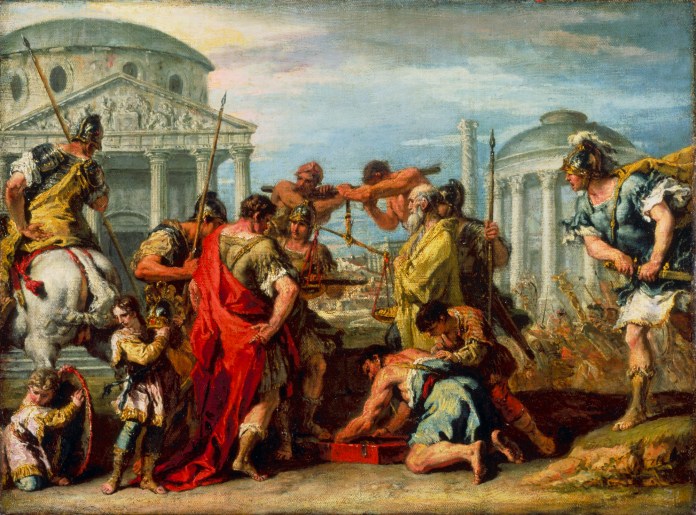
Camillus Rescuing Rome From Brennus, Painted By Sebastiano Ricci (c. 1659–1734)

This scene, painted by the Italian artist Sebastiano Ricci (c. 1659–1734), re-creates one of the legends surrounding the Gallic sack of Rome, which occurred sometime between 390-386 BCE. As the traditional story goes, a rampaging army of Gauls, apparently led by a Senones chieftain named Brennus, ventured further south into Italy than the Gauls were known to usually roam. The Gallic army first attacked the city of Clusium, where Roman envoys were present. Since Rome had prior warning about the incoming Gallic force, they attempted to quickly mobilize an army and cut off the Gauls at the Allia river, yet the attack failed and the bulk of the defeated Roman army fled toward Veii. Brennus and his Gallic army, after their victory, pushed on to the vulnerable city of Rome. They easily stormed inside the walls, and were able to loot much of the city without contest, for the Romans had hunkered down on the Capitol for a final stand. Brennus besieged the Capitol and reportedly forced the Romans to begin negotiating. The Gallic chief asked for a heavy price. His demand for ending the siege was that Rome pay him 1,000 pounds of gold (not including what he already had looted), and the scale that he produced to measure this gold was in no way a fair standard for the Romans. When Rome protested the measuring device, Brennus responded with his famous line, “Woe to the vanquished!” (Livy, History of Rome, 5.48) and told them to keep bringing out the gold.

It was at that moment of humiliation, so the story claims, that the legendary Roman general Marcus Furius Camillus returned from exile with a new army to save the day. As told by Livy, “The argument about the weights had unduly protracted the weighing-out of the gold, and it so happened that before it was finished and the infamous bargain completed, Camillus himself appeared upon the scene. He ordered the gold to be removed and the Gauls to leave…” (History of Rome, 5.49). Such is the scene that Sebastiano Ricci re-creates in his painting, featured above.

Of course, the events surrounding the Gallic sack of Rome are still hotly debated by scholars. There is no question that Rome was truly pillaged by a Gallic army between 390-386 BCE, and it left a permanent ugly stain on the communal memory of the proud Roman people, yet other questions about this obscure time period are left vague by the conflicting and embellished sources. Whether or not the Romans did or didn’t pay the 1,000 pounds of gold is one of those fiercely debated points in the narrative. Whatever the case, at least in Sebastiano Ricci’s artistic interpretation of the story, Camillus was able to stop Rome from paying its embarrassing tribute to the Gauls.

Written by C. Keith Hansley


Sources:

Jonathan Swift

Jonathan Swift (c. 1667-1745)

“Of so little weight are the greatest services to princes, when put into the balance with a refusal to gratify their passions.”

  • Gulliver’s Travels (Voyage to Lilliput, chapter 5) by Jonathan Swift. New York: Washington Square Press, 1970.

The Gruesome Murder Of Governor Callincius Of Cilicia

Callincius was a governor of Cilicia during the reign of Emperor Justinian of Constantinople. Although he did little during his career as a governor to be recorded in the history books, he would eventually become embroiled in a crime that would catch the attention of Constantinople’s most prominent historian of that time—Procopius (c. 490-565). Sadly for Callincius, his story did not have a pleasant ending.

According to Procopius, Governor Callincius was a victim of the raucous politics of Constantinople’s Green and Blue factions. These rival factions were powerful, fanatic and often violent sports fanbases whose activities were known to diverge from athletics into crime and politics. For some reason or other, Callincius evidently ran afoul of the local Blue faction members in the province he was governing. Whatever the unknown discord that erupted between the governor and the Blues might have been, it was enough for members of Cilicia’s Blue faction to instigate a riot or a military mutiny against Callincius. In the ensuing brawl between the sports faction and the governor, the Blues put up a good fight, managing to even kill one of Callincius’ close companions. Nevertheless, the governor ultimately quashed the riot and had two leaders of Cilicia’s Blue faction executed.

Despite overcoming the riot, Callincius’ battle with the Blues was not over. As brute force had not worked, the angry Blues in Cilicia decided to start operating from the shadows. The plan they reportedly hatched was brutal, gruesome, and, unfortunately, successful. According to Procopius, supporters of the Blue faction embarked on an audacious mission for vengeance, “seizing Callincius while he was still in office, and without the slightest pretext impaled him over the murderers’ grave” (The Secret History, chapter 17). Such was the supposed fate of Governor Callincius, impaled over the graves of the Blue faction leaders he had executed.

After news of this assassination spread around the empire of Constantinople, Callincius’ death became the topic of much gossip and rumor. People deliberated about who might have been involved in the assassination, and the list of possible suspects was incredibly lengthy, for supporters of the Blue faction were present in the highest of government offices. Even Emperor Justinian and Empress Theodora were known to be greatly biased in favor of the Blues. As such, it is not surprising that the rumor-mills alleged that the imperial family might have been involved in Governor Callincius’ very public murder.

Written by C. Keith Hansley

Picture Attribution: (Constantine Doukas escaping from Captivity, from the Madrid Skylitzes manuscript, c. 12 or 13th century, [Public Domain] via Creative Commons).


Sources: