Home Blog Page 103

The Odd Attempted Linkage Of Atlantis To The Ancient Greek Gods

Ah, origin stories. Every culture and religion has one, and sometimes they can be quite weird. In the mainstream traditional ancient Greek theology/philosophy, as espoused by authorities such as the poet Hesiod (c. 8th century BCE), a primordial Chasm or Chaos was the originator of early deities like Gaia or Ge (Earth). Gaia, in turn, mated with Ouranos (Heaven), and they begot the Titans. By these offspring, Ouranos was overthrown. Kronos and Rhea, the most prominent Titans, then became the parents of most of the next generation of gods—the Olympians. This latest generation of deities, led by Zeus, overthrew Kronos and went on to further populate the spiritual realm through their loves, affairs, and rapes, but none of these later offspring (in recorded myth) were able to overthrow Zeus. Such, then, is a brief and simplified summary of the traditional, commonplace, myths relating to the creation and ascendance of the major Greek gods. Yet, there were also alternative theological origin stories in circulation. In particular, some later Greek and Roman scholars would push a controversial theory (later famously embraced by the German philosopher Friedrich Nietzsche) that the figures which became known as gods actually had quite human and mundane origins.

One of the scholars who had a tendency to perceive the gods as more flesh than spirit was the Greek-Sicilian historian, Diodorus Siculus (c. 1st century BCE). In his Library of History, Diodorus recorded an alternative genealogy for the gods (who were often described as earthly kings), and he also curiously linked this godly dynasty of ancients to the mythical/legendary civilization of Atlantis. In the beginning of the holy family’s history, claimed Diodorus, there was a royal couple named King Ouranos and Queen Titaea. In this scenario, the so-called ‘Titans’ were Titaea’s children, the most prominent of which were Kronos, Atlas, and a new name in the mix—Basileia. As this alternative story goes, Basileia was the senior Titan and she was the one that succeeded Ouranos and Titaea as ruler of the ancient realm. Yet, her reign was preyed upon by intrigue, and her personal family was ravaged by assassination and other tragic deaths. After losing her husband and her children, Basileia was said to have gone insane and went into exile. The odd narrative went on to claim that this mad Basileia eventually became the inspiration for the cult of Cybele, the Magna Matter goddess, in Phrygia—yet, even Diodorus had to admit that the Basileia-Cybele connection was unpopular and largely unbelieved. Whatever the case, after the downfall of Basileia’s personal family, the kingdom of the gods was divided between her brothers. Diodorus Siculus described the ascendance of these brothers. Be advised, the Loeb Classical Library’s Oldfather translation (c. 1935) of the relevant passage uses some alternative spellings for the names:

“[T]he kingdom was divided among the sons of Uranus [aka Ouranos], the most renowned of whom were Atlas and Cronus [or Kronos]. Of these sons Atlas received as his part the regions of the coast of the ocean, and he not only gave the name of the Atlantians to his people but likewise called the greatest mountain in the land Atlas…Cronus, the brother of Atlas, the myth continues, who was a man notorious for his impiety and greed, married his sister Rhea, by whom he begat that Zeus who was later called ‘the Olympian’” (Diodorus Siculus, Library of History, 3.60-61).

According to this odd theological theory, the Olympian gods and the Atlantian royal family would have been from different branches of the same godly dynasty. Nevertheless, this is not all that surprising, for many ancient Greek cities (and Rome, too) claimed to have been founded, and ruled for a time, by descendants of the Greek gods. Therefore, it would have been more odd if Atlantis had not been in some way connected to the family tree of the gods.

Written by C. Keith Hansley

Picture Attribution: (Feast of the Gods, painted by Abraham Govaerts (c. 1589-1626) and Frans Francken II (c. 1581-1642), [Public Domain] via Creative Commons and the National Museum in Warsaw).


Sources:

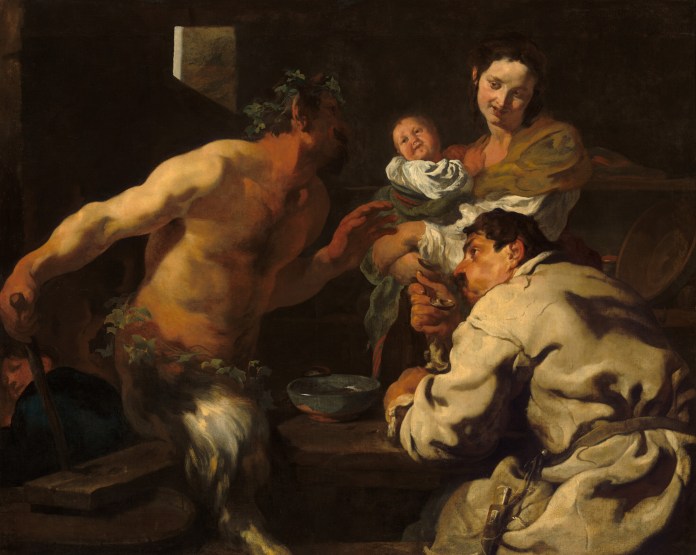
The Satyr And The Peasant, By Johann Liss (1597 – 1631)

This painting, by the German artist Johann Liss (1597 – 1631), was inspired by one of the fables attributed to the legendary tale-teller, Aesop, who was said to have lived in the 6th century BCE. Although the title of the artwork is called “The Satyr And The Peasant,” the particular story from which the artist drew inspiration is often called the fable of “The Man and the Satyr.” Naming differences aside, let’s get on with the story.

As the fable goes, a man was walking through a forest near his house one day when he had a chance encounter with a mythical satyr. The man and creature became great friends, and the satyr eventually was invited to live in the man’s house. As the two walked together on a certain cold day, the satyr was amused to see the man shivering and holding his hands up at his mouth, blowing air on his fingers. The furry-legged satyr, who apparently was immune to the cold, asked the man what he was doing, and the man responded that he was blowing hot air on his hands to keep them warm. This conversation continued until the two reached the man’s home.

During their walk, the man and satyr had worked up an appetite, and they soon began cooking a hot meal—reportedly porridge—to fill their empty bellies. They were so hungry that they did not wait for the food to cool before they sat down to eat. Nevertheless, the man could see that the porridge was too hot, and he began to blow on his serving of porridge, dispersing the steam that was rising up from his meal. It is this part of the fable (the man cooling down his porridge while dining with the satyr) that Johann Liss re-created in his painting. Unfortunately, the friendship of the man and the satyr was ended by this very incident. The satyr was curiously outraged when he learned that the man was now using his breath to cool down food, as opposed to heating up cold hands. After making this realization, the satyr immediately stood up from the table and began to grumpily march back to his own forest homeland. As he left the man’s home, the satyr explained himself by saying, “I’ve seen enough. A fellow that blows hot and cold in the same breath cannot be friends with me!” (Aesop, The Man and the Satyr).

Written by C. Keith Hansley


Sources:

Dante Alighieri

Dante Alighieri (c. 1265-1321)

“The highest Good
Unlimited, ineffable, doth so speed
To love, as beam to lucid body darts,
Giving as much of ardour as it finds.”

  • Dante Alighieri’s Divine Comedy (Purgatory, Canto XV), translated by Henry F. Cary in the Harvard Classics series, edited by Charles W. Eliot, and published by P. F. Collier & Son (1909, 1937).

Gisa—The Unrescued Daughter Of King Grimoald

Emperor Constans II ascended to the throne of the Empire of Constantinople in 641. About two decades later, around the year 662/663, Constans notably left the imperial heartland of Greece behind and relocated himself to Italy.  To the shock of Constantinople, the emperor would stay in Italy for the rest of his life, where he pursued three main objectives—building up imperial power in Sicily, suppressing the influence of the Roman popes, and ramping up war efforts against the Lombards. In regard to the emperor’s campaigns against the Lombards, much of the warfare was focused on southern Italy. In particular, the Benevento region was singled out for attack. Perhaps this was a convenient target due to Benevento’s close proximity to the imperial stronghold of Naples. Emperor Constans II, however, might have had alternative, familial, reasons to attack Benevento.

As it happened, King Grimoald of the Lombards had family who lived among the Beneventines. Romuald, the Lombard duke of Benevento, was reportedly an illegitimate son of King Grimoald, and, although Romuald was not in line to inherit the kingdom, King Grimoald still loved him. Indeed, King Grimoald personally led troops and supplies south as soon as he learned that Benevento was under attack. Grimoald was fast enough in his mobilization and deployment to save Duke Romuald, and flip the Beneventines from defense to offense against Emperor Constans’ armies.  Yet, although he had been quick enough to rescue his son, King Grimoald unfortunately did not have an equal enthusiasm for saving his other imperiled child in the Benevento region—a daughter named Gisa.

Gisa and Duke Romuald shared the same mother, and like the duke, Gisa was also considered an illegitimate child, holding very little clout in the royal family. Gisa lived within her brother’s dukedom in Benevento, but she evidently resided on an estate that was outside of the walls of her brother’s cities and castles. While these living arrangements might have been nice in times of peace, it left Gisa vulnerable when the Benevento region found itself on the frontline of the war between the Lombards and the Empire of Constantinople. In fact, whereas Duke Romuald remained safe behind the walls of the city of Benevento, Gisa’s more remote abode was reportedly discovered and captured by Emperor Constans’ troops. Gisa was taken prisoner by the imperial army, and when the combined forces of King Grimoald and Duke Romuald later drove the forces of Emperor Constans II out of the Benevento region, the imperial troops took Gisa with them.

King Grimoald definitely showed some favoritism between his two illegitimate children in Benevento. The king had rushed south to aid his son, Duke Romuald, and relieved the dukedom of Beneveno. Yet, when the Beneventines changed from the defenders to become the aggressors in the conflict, King Grimoald’s personal leadership in the war began to wane. He let Duke Romuald lead the military operations in southern Italy, and their goals for the war focused more on territorial expansion than on obtaining Gisa’s release.

As King Grimoald and Duke Romuald seemed uninterested in negotiating for the return of Gisa, she unfortunately lived the rest of her life in the custody of the Empire of Constantinople. Emperor Constans II reportedly had her brought to Sicily, and there she remained, even after Emperor Constans II was eventually assassinated by his own people in 668. Unfortunately, Gisa’s status and living conditions in the post-Constans period are vague.  The Lombard historian, Paul the Deacon (c. 720-799), merely wrote, “the daughter of the king, who we said had been carried away from Beneventum as a hostage came to Sicily and ended her last days” (Paul the Deacon, History of the Lombards, 5.14). She reportedly died in 672, the same year that her father, Grimoald, also met his end.

Written by C. Keith Hansley

Picture Attribution: (Lachrymae, painted by Lord Leighton Frederic (c. 1830–1896), [Public Domain] via Creative Commons and the MET).

Sources:

  • History of the Lombards by Paul the Deacon, translated by William Dudley Foulke (c. 1904). University of Pennsylvania Press, 1907, 1974, 2003.
  • Theophanes, The Chronicle of Theophanes, translated by Harry Turtledove. Philadelphia: University of Pennsylvania Press, 1982.

Death Of Messalina, Painted By Francesco Solimena (c. 1657 – 1747)

This painting, by the Italian artist Francesco Solimena (c. 1657 – 1747), was inspired by the historical death of Empress Messalina, a wife of Emperor Claudius (r. 41-54). Messalina had been wed to Claudius before he unexpectedly ascended to the throne, and she reigned alongside him as his consort for nearly a decade. Together, she and Claudius had two children—a son named Britannicus and a daughter by the name of Octavia. Claudius was reportedly quite fond of Messalina, but intrigue and affairs drove them apart.

In the year 48, Messalina reportedly had a dalliance with a certain Gaius Silius (said to be the most handsome man in Rome). This affair, however, got out of hand, and rumors soon spread that she allegedly married him despite her preexisting marriage with the emperor. Even worse, beyond cheating on the emperor, Messalina was soon suspected by Claudius’ spies and advisors of working with Gaius Silius on a plot to usurp power from Claudius and place young Britannicus on the throne. Whether or not these rumors and suspicions were real is vague, but the reports filed by the emperor’s advisors and their informers caused enough actionable suspicion that Claudius began making inquiries into the goings-on of Messalina, Gaius Silius, and their groups of friends.

As the story goes, most of Emperor Claudius’ advisors clamored for Messalina to be sentenced to death. Claudius, however, was struggling to come to a decision, and he reportedly wanted Messalina to be given a chance to defend herself against her accusers. Yet, this would not do for Claudius’ Secretary-General and temporary commander of the emperor’s Guard, Narcissus (who happened to be the official that was most hostile to Messalina). In a move that might have been more self-serving than of service to the emperor, Narcissus was said to have gone around the emperor to order the Guard to execute Messalina. The incident was recorded by the Roman historian, Tacitus (c. 56/57-117):

“So Narcissus hurried away. Ostensibly on the emperor’s instructions, he ordered a Guard colonel, who was standing by, and some staff officers to kill Messalina. A former slave, name Euodus, was sent to prevent her escape and see that the order was carried out. Hastening to the Gardens ahead of the officers, he found her prostrate on the ground, with her mother Domitia Lepida sitting beside her…And so the officer ran her through. The body was left with her mother” (Tacitus, Annals of Imperial Rome, XI.37-38).

It is this morbid scene that Francesco Solimena re-creates in paint. Messalina, with her mother at her side, pleads for her life. Yet, as the quote above foretold, Messalina would not be shown mercy. Several other members of the alleged conspiracy were also executed, including Gaius Silius (Messalina’s partner in the affair), Juncus Vergilianus (a senator), Titius Proculus (Messalina’s guardian), Decrius Calpurnius (commander of the watch), Sulpicius Rufus (a gladiator school superintendent), and three members of the equites order, named Vettius Valens, Pompeius Urbicus and Saufeius Trogus.

Written by C. Keith Hansley


Sources:

The Impressive, Battle-Winning, Stab Of Amalong At The Battle Of Forino

Between the years 662 and 663, Emperor Constans II of Constantinople (r. 641-668) personally sailed off from his base of power in Greece and crossed over to Italy, where he could better focus on Roman and Lombard affairs. While he was in the region, border tensions skyrocketed between the emperor’s own territory and that of the Lombard people, who had occupied much of Italy during the last century. In particular, the emperor’s forces and those of the Lombards were reported to have clashed in the Benevento region, where a Lombard duke named Romuald was ruling. This duke, however, turned out to be a tougher target than the imperial forces had expected.

Duke Romuald, according to Lombard sources, was a bastard son of the then reigning King Grimoald of the Lombards (r. 662-671). Although the duke was not in line to inherit the kingdom, Grimoald still cared for him. As a result, when Benevento was threatened by Emperor Constans’ forces, the king promptly offered Romuald enough troops and supplies to turn the tide of the conflict. Duke Romuald, emboldened by his reinforcements from the Lombard king, decided to go on the offensive. In particular, he targeted an imperial army that was camped at a place called Forinus or Forino, which was not too far from Constantinople-controlled Naples. As told by the Lombard sources, Duke Romuald estimated that the camped force consisted of around twenty thousand men, led by a general named Saburrus. No record was made of the size of the army that Romuald led, but it was large enough for him to not be intimidated by the troops in the opposing encampment.

Among the warriors that King Grimoald lent to Duke Romuald was a spearman named Amalong. He was a tough and experienced fighter who favored a pike as his preferred polearm.  Duke Romuald’s army was well-served having this loaned champion in their midst. Indeed, Amalong would distinguish himself in the fighting that was to come, and his actions were said to have been pivotal in the outcome of the battle.

Duke Romuald led Amalong and the rest of the Lombard forces to the vicinity of Forino, where they confronted the imperial army. At the beginning of the battle, Romuald and Saburrus were balanced in the moves and counter-moves of their deadly game. Lombard and imperial battle lines pressed and ground with no advantage yet showing on either side. Saburrus, hoping to break the deadlock, finally ordered a reserve of cavalrymen to rush into the mix. Nevertheless, the horsemen or their general chose the wrong section of the Lombard army to attack—as the story goes, they charged straight for Amalong’s position, and he was ready for them. What allegedly happened next was recorded by a Lombard historian named Paul the Deacon (c. 720-799). He wrote:

“And while both lines were fighting with great obstinacy, a man from the [Lombard] king’s army named Amalong, who had been accustomed to carry the royal pike, taking this pike in both hands struck violently with it a certain little Greek and lifted him from the saddle on which he was riding and raised him in the air over his head. When the army of the Greeks saw this, it was terrified by boundless fear and at once betook itself to flight…” (Paul the Deacon, History of the Lombards, 5.10).

Based upon Paul the Deacon’s account above, it seems that Amalong held his ground against Saburrus’ cavalry charge, skewering with his pike the unfortunate man who happened to be out front in the formation. Then, by lifting the pierced body high into the sky like a flag, Amalong was able to turn the curious incident into a psychological weapon against the imperial army. Ironically, the cavalry charge which was meant to shock and scatter the Lombards was instead hijacked by Amalong, who shocked and frightened the imperial army with his conspicuous feat of strength. According to the legend, this peculiar event caused Saburrus’ army to crumble. The flight of the imperial forces from the battlefield was reportedly not orderly. One way or another, Saburrus was said to have lost much of his manpower by the time that he contacted Emperor Constans II after the battle. According to Paul the Deacon, Saburrus “returned to him with a few men only and came off with disgrace” (History of the Lombards, 5.10). In contrast, Duke Romuald’s prestige was on the rise. By the time of his death around 677, he had greatly expanded the territory and influence of Benevento into southern Italy.

Written by C. Keith Hansley

Picture Attribution: (Battle between Cavalry and Infantry, by Antonio Tempesta (c. 1555 – 1630), [Public Domain] via Creative Commons and the National Gallery of Art)


Sources:

Tarquin The Elder Consulting Attus Navius, Painted by Sebastiano Ricci (c. 1659 – 1734)

This painting, created by Italian artist Sebastiano Ricci (c. 1659 – 1734), brings to life an interesting legend from the history of ancient Rome. Ricci’s chosen scene reportedly occurred during the reign of King Lucius Tarquinius Priscus (or Tarquin the Elder (r. 616-578 BCE)). King Tarquin, as the story goes, clashed with a prominent augur, known as Attus Navius, after the omen reader presented an unfavorable interpretation of omens in regard to the Roman king’s endeavors. Angered by the outcome of the divination, King Tarquin belittled Attus Navius’ craft. Yet, besides mere criticism, the king decided to play a nasty trick on the augur in hopes of humiliating and discrediting the man. According to the legend, however, Attus Navius had the last laugh. The tale was recorded by the Roman historian, Livy (59 BCE- 17 CE):

“Tarquin was very angry. ‘Ho ho!’ he cried with a contemptuous laugh; ‘then I would ask you, holy sir, to declare by your gift of prophecy if what I am thinking of at this moment can be done.’ His object, the story goes, was to ridicule the whole business of omens; but Navius was unperturbed. He took the auspices, and replied that the thought in the king’s mind would, indeed, be realized. ‘Very well,’ said Tarquin, ‘I was thinking that you would cut a whetstone in half with a razor. Get them, and do what those birds of yours declare can be done.’ Believe it or not: without a moment’s delay Navius did it” (Livy, History of Rome, 1.36).

Such is the scene that is occurring in Sebastiano Ricci’s painting. Instead of a whetstone, Ricci gave Attus Navius a tougher challenge of cutting a fallen pillar in half. Nevertheless, Navius has his razor ready to prove disbelieving King Tarquin wrong.

Written by C. Keith Hansley


Sources;

The Crash And Camel Stories Of The Colossus Of Rhodes

The Colossus of Rhodes, one of the so-called Seven Wonders of the Ancient World, was a bronze and iron statue of the sun-god, Helios, that was designed by Chares of Lindos and built between 294/292 and 282/280 BCE. Rhodes’ Colossus was commissioned to celebrates the Rhodesian survival of a blockade carried out by the Macedonian king, Demetrius I Poliorcetes, in 305 BCE. Standing proudly at the Mandrákion harbour, the Colossus was said to have towered up to around 32 meters (or 105 feet) tall. But all good things come to an end, including giant Helios’ balance. Unfortunately for the Rhodesians, the Colossus of Rhodes fell during an earthquake around 226 BCE. The Roman geographer, Strabo (c. 64 BCE-24 CE), wrote of the Colossus’ rise and fall: “most remarkable is the Colossus of the Sun [Helios], which, the author of the iambics says, was ‘seventy cubits in height, the work of Chares of Lindus.’ It now lies on the ground, having been thrown down by an earthquake, and is broken off at the knees” (Strabo, Geography, 14.2.5). Despite the toppling of the Colossus, it remained a great tourist attraction and was still considered one of the Seven Wonders of the World.

Over the next centuries, the ruins of the Colossus of Rhodes remained remarkably intact, with great quantities of the statue’s valuable bronze remaining at the original site, undisturbed, despite the rise, change, or fall of Mediterranean civilizations that was occurring around its resting place. Nevertheless, the Colossus’ surprising record of remaining relatively un-looted would end when Muawiyah (Muʿāwiyah ibn Abī Sufyān)—the Muslim governor of Damascus and Syria—began launching attacks on the Anatolian coast and nearby islands. After successfully taking Cyprus in 649, Muawiyah next turned his attention to Rhodes, which he successfully conquered in 654.

News of the capture of Rhodes piqued the interest of merchants operating in the lands that Muawiyah controlled. As the story goes, some deal was struck in which the bronze metal of the Colossus of Rhodes was purchased by a merchant, and permission was given by Muawiyah for the remains of the statue to be scrapped and shipped off to wherever the buyer wanted the bronze to go. The incident was recorded by a chronicler from Constantinople, named Theophanes (c. 750s-818). For his entry describing Annus Mundi 6145 (aka 653-654 CE), Theophanes wrote, “In this year Muawiyah over ran Rhodes and destroyed the Colossus of Rhodes…[A] merchant from Edessa bought it and carried off its bronze on nine hundred camels” (Theophanes, Chronographia, Annus Mundi 6145). No further precise details about the excavation and gathering of the bronze was preserved, so there is no way to know (besides theoretical estimates) the original down-payment that the statue’s materials were purchased for, or the weight or value of the hauled bronze, itself. Yet, for nine hundred camels to be allegedly involved in transporting the metal, there must have been a great quantity of bronze still left at Rhodes. If the Colossus had been completed in 280 BCE, then its bronze remains would have been on the island of Rhodes for 934 years when the downfallen monument was cut up and hauled away in the year 654.

Written by C. Keith Hansley

Picture Attribution: (cropped scene of the Colossus of Rhodes, created in the 16th century by Maarten van Heemskerck, Hadrianus Junius and Philips Galle, [Public Domain] via Creative Commons and the Rijksmuseum).


Sources:

Rinaldo And The Mirror-Shield, Painted By Francesco Maffei (c. 1605 – 1660)

This painting, by the Italian artist Francesco Maffei (c. 1605 – 1660), re-creates a fantastical episode from the poetic works of Torquato Tasso (c. 1544-1595). Maffei’s chosen scene comes from Tasso’s poem, Gerusalemme liberata (or The Liberation of Jerusalem), which has a plot set in the time of the First Crusade (c. 1095/1096-1099). The tale it tells, though, is far from historical, featuring many fictional characters, as well as wizards, witches, and a varied host of monsters and supernatural beings. In regards to this painting, Francesco Maffei chose to depict a portion of one of the most outlandish and unhistorical episodes from Tasso’s poem.

As a prologue to the painted scene, one of Tasso’s fictional crusader characters, Rinaldo, was kidnapped by a similarly fictional witch, named Armida. She was completely in love with her captive knight, and she magically whisked him away to an island lair that was guarded by mythical and legendary monsters. Despite being held against his will, Rinaldo, likewise, became quite smitten with his magical captor. Before long, Armida totally bewitched him, and the emotional snares she laid on him were not all caused by witchcraft.

In Tasso’s fictional plot, the Crusader army sent a rescue party after Rinaldo. These rescuers were Carlo and Ubaldo (or Charles and Hubald), and they had magical allies of their own. First, they encountered the so-called Magus (or Sage) of Ascalon, who armed them with a magical golden rod, and they were also ferried to Armida’s island on a ship that was provided by the goddess, Fortune. After warding off the island’s monsters with their magic wand, Carlo and Ubaldo were able to find Rinaldo, and they were horrified to see that Armida had given him a flowery makeover. To share their horror with their bewitched friend, the rescuers decided to hold up a reflective shield in front of Rinaldo’s face, so that he could see his reflection as if he were looking in a mirror. Torquato Tasso described the scene:

“Hubald meanwhile stands facing him to wield,
raising it toward his face, the adamant shield.
He on the bright escutcheon turns his gaze
that shows what kind of man he has become
and how finely decked out. Sweet perfume plays
the wonton in his hair and cloak. Struck dumb,
he sees his sword, his very sword, ablaze
with womanish gauds, to luxury succumb.
Adornment makes it seem a useless toy,
not the fierce tool a soldier might employ.”
(Torquato Tasso, Gerusalemme liberata, Canto 16, stanzas 29-30).

It is this scene that is being re-created in Francesco Maffei’s painting. On the right side of the canvas, Rinaldo can be seen staring into the reflective mirror that is held up Ubaldo or Hubald. In the aftermath of this incident, Rinaldo would agree to abandon Armida and return to the crusade. Yet, by the end of Torquato Tasso’s poem, Rinaldo and Armida would reconcile and resume their relationship.

Written by C. Keith Hansley


Sources:

Chief Joseph

Chief Joseph
(Nez Percé/Nimiipuu leader, c. 1840-1904)

“I have heard talk and talk, but nothing is done. Good words do not last long until they amount to something.”

  • Chief Joseph’s Own Story (paragraph 84), by Chief Joseph, originally published in 1879; republished with an introduction by Bishop W. H. Hare and General Howard’s Comment in The North American Review (1879). Reprinted by Kessinger Publishing, 2010.