
Home Blog Page 94

Achilles Among The Daughters Of Lycomedes, Painted By Jan Boeckhorst (c. 1604-1688)

This curious painting was created by Jan Boeckhorst (c. 1604-1688), an artist who was born in Germany but operated in the Flemish art scene. Boeckhorst’s painting draws inspiration from ancient Greek mythology, re-creating a peculiar myth (albeit with touches of fashion, weaponry and architecture from his own time) about Achilles’ recruitment into the Trojan War. As the story goes, Achilles’ parents—the Nereid nymph Thetis and King Peleus of the Myrmidons at Phthia—received a prophecy that their son would die in the Trojan War. Horrified by this oracle, the worried parents decided to hide their son from the Greek recruiters who were mobilizing the might of Greece for war. To achieve their objective, Peleus and Thetis smuggled Achilles to King Lycomedes on the island of Scyros, where they hoped to disguise Achilles as a woman and hide him among Lycomedes’ large household of daughters. There, Achilles’ parents hoped that their costumed son could blend in with the princesses at Scyros and avoid the war. The ploy worked for a time, and it might have succeeded in the long run, too, had cunning and observant Odysseus not been the recruiter searching for Achilles. A scholar known as Pseudo-Apollodorus (c. 1st-2nd century) summarized the ancient accounts of the tale:

“When Achilles was nine years old, Calchas declared that Troy could not be taken without him, but Thetis—who knew in advance that he was fated to be killed if he joined the expedition—disguised him in women’s clothing and entrusted him to Lycomedes in the semblance of a young girl…Achilles’ whereabouts were betrayed, however, and Odysseus, searching for him at the court of Lycomedes, discovered him by causing a trumpet to be sounded. And so it came that Achilles went to Troy” (Apollodorus, Library, 3.13.8).

Such is the scene that is unfolding in the painting. It either shows Achilles relinquishing his weapons and armor as he is being originally disguised in womanly clothing by Lycomedes’ household. Or, perhaps, it shows Achilles taking up his sword and shield once again after being discovered by Odysseus, and the women are instead reclaiming the jewelry that they had loaned Achilles during his costumed stay. Whatever the case, it is this myth of Achilles at Scyros that the painting depicts.

While the tale of Achilles with the daughters of Lycomedes was a popular story, there were competing narratives. Most notably, Homer wrote a totally different story in The Iliad, in which an undisguised Achilles eagerly and excitedly accepted Odysseus’ invitation to join the Trojan War. Homer wrote a scene where the character, Nestor, reminisced about recruiting Achilles and his friend Patroclus, saying, “We had come to Phthia and the welcoming palace of Achilles’ father Peleus to recruit troops…At that moment, Odysseus and I appeared at the gate. Achilles was amazed and sprang to his feet, took us by the hand, brought us in…I began to speak, urging you [Patroclus] and Achilles to join us. You were more than willing, and your fathers both started giving you advice” (Homer, The Iliad, book 11, approximately lines 770-780). Nevertheless, Jan Boeckhorst (c. 1604-1688) obviously rejected Homer’s version of Achilles’ recruitment, and instead opted for the alternative tale of Achilles being discovered among Lycomedes’ daughters.

Written by C. Keith Hansley


Sources:

  • Apollodorus, The Library of Greek Mythology, translated by Robin Hard. New York, Oxford University Press, 1997.
  • The Iliad by Homer, translated by E. V. Rieu and edited/introduced by Peter Jones. New York: Penguin Classics, 2014.
  • https://cyfrowe.mnw.art.pl/en/catalog/506201
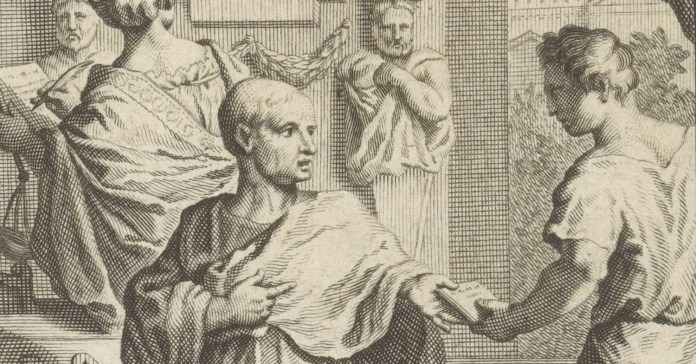
Paid Applause In The Roman Centumviral Court

Rome’s Centumviral Court, often equated to chancery courts or courts of equity, was the legal arena in which ancient Roman lawyers arbitrated common/private/civil law cases. The Centumviral Court was the usual haunt of Pliny the Younger (c. 61/62-113), who became a lawyer when he was eighteen years old and eventually specialized in inheritance and financial law. Pliny practiced law in the Centumviral Court for decades (in addition to work in other legal and governmental fields). Over the years, Pliny the Younger found that there were quirks and gimmicks in the Centumviral Court that he deemed to be quite annoying, and near the top of that list of irritating fads was a curious trend that involved lawyers hiring audiences of paid applauders to cheer them on while Centumviral Court cases were in session. Pliny the Younger, personally, blamed a certain lawyer named Larcius Licinus (c. 1st century) for starting the craze by sending invitations (at first without any money involved) that asked for people to attend his court speeches. As Larcius Licinus’ audiences and supportive cheers grew through these means, younger lawyers apparently decided to start imitating his tactics. Among the new generations of lawyers in the Centumviral court, the trend became worse instead of better, eventually evolving into the pay-for-applause scheme that Pliny detested.

In a curious letter written to a man named Maximus, Pliny the Younger embraced his inner grumpy old man and ranted against the uncouth young whippersnappers in the Centumviral Court who were involved in the practice of buying applause. Pliny wrote of his own experience of having applause-recruiters try to hire his own attendants to cheer for a different lawyer, saying, “Yesterday two of my attendants (who would only just have come of age if they were citizens) were induced to add their applause for three denarii each. That is all it costs you to have your eloquence acclaimed” (Pliny the Younger, Letters, 2.14). He continued that young wannabe orators with more money than they knew what to do with would spend small fortunes to fill the audience seats with fake adoring fans, hoping that having cheering masses in the court rooms would somehow boost their careers. Worst of all, with speakers relying on money instead of speechcraft to win applause, the quality of speeches and logical argument among lawyers was (according to Pliny) on a steady decline. In conclusion, Pliny the Younger pessimistically stated “the man who raises the most cheers is the worst speaker” (Pliny the Younger, Letters, 2.14). These poor experiences in the Centumviral Court made Pliny the Younger look fondly on the prospect of retirement.

Written by C. Keith Hansley

Picture Attribution: (Cropped section of an image labeled Cicero en schrijvende vrouw, anonymous, 1689, [Public Domain] via Creative Commons and the Rijksmuseum).


Sources:

  • The Letters of Pliny the Younger, translated by Betty Radice. New York: Penguin Classics, 1963, 1969.

Study for “Antiochus and Stratonice” by Pompeo Batoni (c. 1708-1787)

This painting, by the Italian artist Pompeo Batoni (c. 1708-1787), was an early practice attempt (or “study”) that was made while the artist endeavored to re-create the legend of Antiochus and Stratonice from the history of the Seleucid Empire. In regard to Batoni’s painting, the Antiochus featured in this tale is represented on canvas by the shirtless man seen lying in bed, covered by an orange-shaded sheet. As can be surmised by his bedridden state, Antiochus was an ill man during the time of the legend being re-produced in paint, and therefore he had an attending physician—named Erasistratus—who is seen sitting at the left side of the canvas. In the center of the painting, standing over the sick young man, is Antiochus’ regal father, King Seleucus I Nicator (r. 305-281 BCE), cloaked in blue and wearing a crown. Beside the king is Seleucus’ wife, Queen Stratonice, dressed in shades of red, white and gold. With that, the main characters of the legend in question have been introduced, and we can carry on with an account of the story that inspired the painting.

Antiochus’ mysterious illness, and the physician Erasistratus’ investigation into the ailment’s causes and cures, are central elements to the story that is being re-created in the painting above. As the story goes, the physician quickly developed a hypothesis after he began observing the sickly prince’s reaction to guests that came to visit. In the opinion of the healer, Antiochus’ illness was a classic case of lovesickness, and the woman for whom the prince was pining after would cause a scandal in the Seleucid court. Pompeo Batoni depicts the physician, Erasistratus, in the act of proving his hypothesis, and his discovery would lead to both a divorce and a marriage. The ancient Greek-Roman biographer, Plutarch (c. 50-120), narrated the tale of what allegedly occurred in that room:

“[Erasistratus] perceived quite easily that he was in love, and wishing to discover who was the object of his passion (a matter not so easy to decide), he would spend day after day in the young man’s chamber, and if any of the beauties of the court came in, male or female, he would study the countenance of Antiochus, and watch those parts and movements of his person which nature has made to sympathize most with the inclinations of the soul. Accordingly, when any one else came in, Antiochus showed no change; but whenever Stratonicé came to see him, as she often did, either alone, or with Seleucus, lo, those tell-tale signs of which Sappho sings were all there in him, — stammering speech, fiery flushes, darkened vision, sudden sweats, irregular palpitations of the heart, and finally, as his soul was taken by storm, helplessness, stupor, and pallor” (Plutarch, Parallel Lives, Life of Demetrius, chapter 38).

Such is the scene that is occurring in the painting above. After this awkward incident, King Seleucus divorced himself from Stratonice in 294 BCE, and let her become the wife of Antiochus. Whether or not this is how their relationship truly began, the historical figures of Antiochus and Stratonice indeed married and had at least five children together.

Written by C. Keith Hansley


Sources:

  • Plutarch’s Life of Alexander in The Age of Alexander: Ten Greek Lives by Plutarch, translated by Ian Scott-Kilvert and Timothy E. Duff. London: Penguin Classics, 1973, 2011.
  • https://www.clevelandart.org/art/2008.69

Murasaki Shikibu

Murasaki Shikibu (c. 11th century)

“It does not suit me to be so busy with affairs, whether the government’s or my own. I must manage to live more as I please.”

  • From Murasaki Shikibu’s The Tale of Genji (chapter 19), translated by Royall Tyler (Penguin Classics, 2003).

Eystein’s Shipwreck Settlement In Iceland

A Norwegian named Eystein decided to sail to Iceland during the so-called Age of Settlement period (c. 860-930). His father had been a figure with the impressive name of Thorstein Rock-Man, and their ancestral land had been in the Halogaland region of northern Norway. Eystein’s motivations for relocating are unknown, but for whatever reason, he packed up as much as he could onto a ship and sailed to Southern Iceland, approaching the coastline not far to the east of Reynisfjara Beach. Yet, Eystein’s ship never reached shore, and he had a rocky start to his new life in Iceland—or, rather, a watery start.

Eystein, so the story goes, experienced a problem with his ship as he was pulling in toward the Icelandic coastline. Specifics are not known, but his ship suffered catastrophic damage, causing heavy timbers from the vessel to fall in the form of dangerous debris. As the medieval Icelandic Book of Settlements (Landnámabók) briefly reported, “He was shipwrecked and was injured by the timber” (LandnámabókSturlubók manuscript, chapter 330). Thankfully, Eystein must have inherited some of his father’s Rock-Man physique, so he shrugged off the wound and was able to successfully reach shore. Despite losing all of his belongings, Eystein was able to slowly but surely recover, eventually building a home for himself and settling down to live a quiet life.

Written by C. Keith Hansley

Picture Attribution: (cropped section of an Image labeled Fotoreproductie van (vermoedelijk) een prent genaamd The Sailor Boy’s Dream of Home, anonymous, c. 1850 – c. 1870 , [Public Domain] via Creative Commons and the Rijksmuseum).


Sources:

  • The Book of Settlements (Sturlubók version), translated by Hermann Pálsson and Paul Edwards. Winnipeg: University of Manitoba Press, 1972, 2006.

Althaea, Attributed To Henry Price Bone (1779-1855) Or Charles Leslie (c. 1835-1863)

This drawing, attributed to the English artists Henry Price Bone (1779-1855) or Charles Leslie (c. 1835-1863), drew inspiration from the vengeful myth of Althaea (or Althaia). According to the ancient Greek tales, Althaea was a daughter of King Thestius of Aetolia, and she later married King Oeneus of Calydon. Together, Althaea and Oeneus had many children, but the artwork above is connected to one child in particular—Meleager.

Meleager, unfortunately, was a lad who became tied to a dangerous prophecy during his infancy. His childhood myth was summarized by the scholar known as Pseudo-Apollodorus (c. 1st-2nd century), who wrote, “When he was seven days old, it was said that the Fates appeared and announced that Meleager would die when the log burning on the hearth was fully consumed. In response, Althaia snatched it from the fire and placed it in a chest” (Apollodorus, Library, 1.8.2). Due to Althaea’s quick thinking, Meleager grew to adulthood, becoming a stereotypical strong and brave hero of ancient Greek myth.

Regrettably, Meleager’s father was not as cunning and spiritually savvy as Althaia. Whereas the queen had been able to outwit the Fates and protect her son from an early death, King Oeneus—in contrast—was careless enough to forget to appease the goddess Artemis with adequate offerings and sacrifices. As punishment for King Oeneus’ religious negligence, Artemis unleashed a monstrous boar against Calydon. Faced with this existential threat, King Oeneus brought together the greatest hunters available in Greece and sent them on a quest to battle the so-called Calydonian Boar.

Unfortunately, the plot of what happened next begins to branch into different variations of the same myth. In all variants, the Calydonian Boar was killed, and the hunters that landed the significant blows were usually described as Meleager, Atalanta, Amphiaraos, and Iphiclos. The different versions also agree that the hunters quarreled over who would be credited with landing the killing blow, as well as who should receive the beast’s prized hide. Additionally, Meleager fell in love with the huntress, Atalanta, during the expedition, so he insisted that the glory and spoils should go to her. Other hunters did not agree, and therefore the debate erupted into bloodshed. The scale of the fight that ensued varied from version to version. In some iterations of the myth, Meleager had a deadly brawl with his naysayers. In other tellings of the tale, the conflict escalated into war. Whatever the case, either in a brawl or in a battle, Meleager was said to have killed several of his uncles who were competing with him in the Calydonian Boar hunt.

Tragically, the uncles that Meleager had killed were the brothers of his mother. Althaea, when she learned of the killings, became engulfed in a fit of rage. Pushed on by a drive to avenge her brothers, Althaea located the dusty old chest that contained the charred piece of firewood linked to Meleager’s lifespan. Casting her maternal instincts aside, Althaea emptied the magical contents of the box onto a fire and let it burn. As told by the aforementioned Apollodorus, “Althaia was so distressed by the loss of her brothers that she rekindled the log, bringing Meleager’s life to a sudden end” (Library, 1.8.3). It is this scene that the drawing re-creates. Althaea can be seen casting the log back into the fire, thereby relinquishing her son Meleager into the hands of the Fates that wished him dead.

Written by C. Keith Hansley


Sources:

Bishop John of Bergamo’s Legendary Taming Of A Wild Horse

Saint John of Bergamo was consecrated as leader of the Bergamascan or Bergamasque bishopric in 656, and he would continue serving as the Bishop of Bergamo for more than three decades. Bishop John’s reign as the religious leader in the Lombard dukedom of Bergamo coincided with the heydays of several colorful Lombard kings, including King Aripert I (r. 653-661), King Grimoald (r. 662-671), King Perctarit (r. 671-688), and King Cunincpert (r. 688-700). Although the aging bishop of Bergamo did not last long into King Cunincpert’s reign (he may have only lived two years into the king’s sovereignty), the two were said to have crossed paths and caused enough drama in their limited time together for folktales and legends to be born.

Saintly Bishop John of Bergamo, so the story goes, was an opinionated and outspoken man, especially when it came to matters of faith and character. Perhaps, this pointedly talkative characteristic became more pronounced when Bishop John was feeling merry and emboldened at a banquet. Such a possibility was primed to occur when Bishop John and King Cunincpert happened to attend the same feast sometime between 688 and 690.

As was the case of many medieval monarchs, King Cunincpert was a man of noticeable flaws and shortcomings. Bishop John of Bergamo, being naturally inclined to critique impious and immoral behavior, might have used the banquet as an opportune teaching moment, perhaps taking the time to launch verbal jabs at King Cunincpert’s unacceptable past behavior, and suggesting better methods of action in the future. Whatever the case, old Bishop John of Bergamo said something that infuriated the thin-skinned king, and Cunincpert began plotting for revenge. With an aim of pranking, injuring or worse, King Cunincpert allegedly arranged for the bishop to be secretly given an unmanageable horse as a mount. A Lombard historian named Paul the Deacon (c. 720-799) narrated this odd tale:

“Since he [Bishop John] had offended king Cunincpert while they were conversing at a banquet, the king commanded to be prepared for him when he was returning to his inn a fierce and untamed horse who was accustomed to dash to the earth with a great snorting those who sat upon him. But when the bishop mounted him he was so gentle that he carried him at an easy gait to his own house. The king, hearing this, cherished the bishop from that day with due honor and bestowed upon him in gift that very horse…” (Paul the Deacon, History of the Lombards, 6.8).

Maybe it was a miracle; or perhaps, Bishop John was simply a talented horseman. Whatever the case, the tale left an impression on the medieval Italians and no doubt contributed to Bishop John of Bergamo’s reputation as a saint. Although no precise date of death is certain, Bishop John is thought to have died around the year 690, whereas his newfound admirer, King Cunincpert, continued to reign over the Lombards until the year 700.

Written by C. Keith Hansley

Picture Attribution: (Theodore on a donkey surrounded by bishops and monks, by Reinier Vinkeles I (c. 19th century), [Public Domain] via Creative Commons and the Rijksmuseum.jpg).


Sources:

Syrinx, by Carroll Beckwith (c. 1852-1917)

This colorful and slightly abstract painting, by the American artist Carroll Beckwith (c. 1852-1917), was inspired by a sculpture from Simon Mazière (c. 1649-1722). The statue and painting both reference a sad myth from ancient Greece about an unfortunate naiad nymph named Syrinx. As was all too common for the frequently victimized nymphs in Greek mythology, Syrinx was pursued by male deities who refused to take “No” for an answer. In Syrinx’s case, her relentless and overly-persistent pursuer was the insatiable satyr-god, Pan. In their final encounter, wild Pan decided he was done with talk and courtship, instead opting to chase down Syrinx by force. Fortunately, this particular nymph was an admirer of the hunter-goddess Artemis, and she had trained herself to mimic some of her idol’s athleticism. Pan was not disheartened by the chase. He pursued her, slowly gaining ground and eventually cornering her at a riverbank. It was at that time, when the lusty satyr was closing in, that Syrinx called on her power as a naiad (and on the assistance of other nearby water nymphs) in order to undergo a transformation that would spare her from the clutches of Pan. The Roman poet, Ovid (43 BCE-17 CE), described Syrinx’s appearance, her escape, and her final transformation:

“In the cold Arcadian mountains,
among the Nonácrian wood-nymphs, there lived a remarkable naiad
(Syrinx her sisters called her), whom all admired for her beauty.
More than once she’d eluded pursuit by lascivious satyrs
and all the various gods who dwell in the shadowy forests
and fertile fields. She modelled herself on the goddess Diana [Artemis]
in daily life and by staying chaste.

the nymph rejected the god’s advances
and fled through the fields, until she arrived at the river Ladon
peacefully flowing between its sandy banks. Since the waters
were barring her way, she called on the nymphs of the stream to transform her.
So just at the moment when Pan believed that his Syrinx was caught,
instead of a fair nymph’s body, he found himself clutching some marsh reeds.”
(Ovid, Metamorphosis, 1.689-706).

Syrinx’s metamorphosis is captured in Carroll Beckwith’s painting, depicting the naiad nymph in the middle of her transformation into a patch of reeds. Unfortunately for Syrinx, her magic spell did not stop Pan from abusing her. As the story goes, it is none other than Syrinx’s own newly-grown reeds that Pan harvested to make his famous reed pipe. Therefore, Pan kept with him a portion of the nymph that got away, fondling it often with his fingers and his lips.

Written by C. Keith Hansley


Sources:

Giovanni Boccaccio

Giovanni Boccaccio (c. 1313-1375)

“The Muses are ladies, and although ladies do not rank as highly as Muses, nevertheless they resemble them at first sight, and hence it is natural, if only for this reason, that I should be fond of them. Moreover, ladies have caused me to compose a thousand lines of poetry in the course of my life, whereas the Muses have never caused me to write any at all.”

  • The Decameron (Fourth Day, Introduction) by Giovanni Boccaccio, translated by G. H. McWilliam. New York: Penguin Classics, 2003.

The Viking-British Sibling Settlers Of Iceland

Two brothers, Hildir and Hallgeir, along with their sister, Ljot, journeyed to Iceland during the so-called Age of Settlement (c. 860-930). This trio reportedly came from the British Isles, but no specific details were given about their place of birth. On their origins, the medieval Icelandic Book of Settlements (Landnámabók), simply said that they “were of British stock” (LandnámabókSturlubók manuscript, chapter 349). Perhaps places such as Ireland, the Hebrides, Orkney, Shetland, and the Faroes could be taken off the list, for the authors of Iceland’s early texts and sagas seemed quite knowledgeable about who came to Iceland from these particular places, often specifically mentioning the islands by name in their accounts of early immigrants to Iceland. Maybe the vagueness of Hildir, Hallgeir and Ljot’s place of origin means they were born on the British mainland, such as in the Danelaw of England—a relatively uncited place in the stories of Icelandic settlers. Whatever the case, as the Book of Settlements claimed, the siblings had British blood from one place or another.

Given that Hildir, Hallgeir and Ljot were dated to the Age of Settlement period (860-930), their early life in Britain must have been quite turbulent. The so-called Great Heathen Army of Vikings had arrived in England around 865 and began wreaking havoc on the kingdoms there, rampaging through Kent in 865, then marauding around East Anglia by 866, conquering Northumbria in 867, and invading Mercia in 868. Viking Armies repeatedly clashed with King Alfred the Great of Wessex (r. 871-899). King Alfred made peace with (or bought off) Vikings in his inaugural year as king in 871, and made peace agreements two more times with Vikings between 875-877. Guthrum’s famous invasion of Wessex began in 878, temporarily driving King Alfred into hiding, but the king of Wessex recovered and defeated the invasion with a counterattack within the year. Alfred the Great later had to defend against a new wave of Viking raids that began around 892, but by then he had reformed Wessex’ military and therefore the Vikings found England to be a much harder target to pillage. The English counter-attack against the Vikings and the Danelaw was continued by Alfred’s children, King Edward the Elder of Wessex (r. 899-924) and Queen Æthelflaed of Mercia (sole rule c. 911-918), and the family dream of bringing all of England under the dynasty’s control was cinched by Alfred’s grandson, King Athelstan (r. 925-939). An environment such as this, or similar waves of warfare that were simultaneously occurring in Ireland and Scotland, were what Hildir, Hallgeir and Ljot would have been sailing away from when they decided to move to Iceland in the late 9th century or early 10th century.

After departing from the British Isles, Hildir, Hallgeir and Ljot sailed to southern Iceland, settling close together along the mainland coast at a site opposite the Vestmannaeyjar archipelago. Each of the siblings, as was common of early Icelandic settlers, named their estates after themselves. Hildir’s home became known as Hildir’s Isle, while Hallgeir settled at the similarly-named Hallgeir’s Isle. Ljot, however, changed things up slightly by naming her home Ljotarstead.

Written by C. Keith Hansley

Picture Attribution: (Cropped section from illustration till Herrauds och Bosa Saga, by Pehr Hörberg (c. 1746-1816), [Public Domain] via Creative Commons and the National Museum of Stockholm Sweden).


Sources: