Home Blog Page 130

The Self-Sacrificing Duel Of A Lombard Sentry

In the year 590, Frankish King Childebert II of Austrasia (r. 575-595) launched his largest invasion of Lombard-controlled Italy. He had been sporadically attacking the Lombards since 584, after being paid to do so by Emperor Maurice of Constantinople (r. 582-602). Childebert’s previous major pushes into Lombard territory, occurring around 584 and 588, had been met with stalemate and military defeat, especially the latter of the two campaigns, in which the Lombards inflicted a heavy slaughter on the invading Franks. Hoping for a better result in his 590 campaign, King Childebert mustered a larger army and attempted to increase his coordination with his ally, Emperor Maurice. Just how many troops Childebert sent into Italy is not known, but he reportedly tasked twenty of his subservient dukes to be involved in the campaign. After invading, the Franks quickly pressed deep into Lombard territory, threatening the important cities of Milan and Pavia. Meanwhile, the forces of Emperor Maurice advanced from central Italy, taking cities such as Modena and Mantua. It was a tough position for the Lombards to be in, but they were, by now, experienced at fighting the Franks and the Eastern Romans.

King Authari was the ruler of the Lombards at the time of this invasion, and he had been in charge since 584. His plan in this instance was apparently to wage the war from a defensive mindset—sacrificing certain forts and not engaging in hopeless pitched battles, while also keeping control of major cities. It was a gamble of attrition in which King Authari hoped his Lombard forces could outlast the Franks and the imperial troops until winter and lack of supplies drove the invaders back to their homes. This plan, according to an interesting legend, might have been thwarted if not for the presence of a certain sentry who was serving in one of the Lombard armies.

As the story goes, the Frankish invaders suspected that a large force of Lombards was camped in the vicinity of Lakes Maggiore and Lugano, near Milan. This particular band of Lombards had been killing Frankish looters and had even ambushed one of the Frankish dukes, ending his life. King Childebert’s forces scoured the land between the lakes, trying to spot the hiding Lombards. The two opposing forces apparently almost clashed near Lake Lugano. Yet, according to the tale, it was the Lombards who spotted the Franks first. Instead of waiting and watching, one of the sentries in the Lombard force made himself known to the Franks, showing himself at the bank of a river that divided the land between him and the invaders. A contemporaneous bishop of that time, Gregory of Tours (c. 539-594), recorded the tale of what happened next:

“The Franks learned that the Longobards [aka Lombards] were encamped on the bank of this stream. They marched towards it, but, before they could cross the water-course which I have described to you, a Longobard stood up on the opposite bank, wearing a cuirass and with his helmet on his head, and waved a spear at them. He issued a challenge to the Frankish army…A few of the Franks managed to cross. They fought with this Longobard and killed him” (Gregory of Tours, History of the Franks, X.3).

Although the demise of the Lombard sentry was stated with brevity by Gregory of Tours, he must have delayed the Franks for a long while. It was vital that he occupied the Frankish forces for as long as possible, as—according to the story—the unnamed sentry was playing a pivotal role for his comrades. While the sentry taunted the Franks and challenged them to duels, the nearby Lombard army was allegedly packing up their gear to head for safer land. In the end, the sentry’s mission was apparently a great success. According to the aforementioned Gregory of Tours, “the main force of the Franks crossed over, but not a single Longobard could they discover. All they found were the traces of their encampment, where their fires had been lit and where they had pitched their tents. The Franks returned to their camp, having failed to take a single prisoner” (Gregory of Tours, History of the Franks, X.3).

Through escapes such as this, the Lombards were able to keep their military intact. King Authari was able to manage the defense of the Lombard realm from the relative safety provided by the walls of Pavia. Before the year 590 was over, the Franks lost the will to continue the fight and withdrew from Italy. Lombard diplomats entered the lands of the Franks to arrange a peace deal, but King Authari died before the arrangement could be reached.

Written by C. Keth Hansley

Picture Attribution: (Two Knights from a 13th or 14th century manuscript of the ‘Smithfield Decretals’ (labeled BL Royal 10 E IV, f. 105 at the British Library), [Public Domain] via Creative Commons).

Sources:

  • The History of the Franks by Gregory of Tours, translated by Lewis Thorpe. New York: Penguin Classics, 1971.

The Sacrifice Of Polyxena, Painted By Giovanni Francesco Romanelli (c. 1610-1662)

This painting, created by the Italian artist Giovanni Francesco Romanelli (c. 1610-1662), was inspired by the tragic myth of Polyxena. She was the daughter of King Priam and Queen Hecuba of Troy, and, after being captured by the Greeks at the end of the Trojan War, Polyxena’s fate seemed to be leading down the path of enslavement. She, her mother, and other women of Troy were dragged to the fleet of Greek ships, which would carry the captives to strange new homes across the Aegean. Yet, unfavorable weather prevented the Greek fleet from setting out to sea. As told in Euripides’ tragedy, Hecuba (dated to 424 BCE), and reimagined centuries later in the Metamorphoses of the Roman poet, Ovid (c. 43 BCE- 17 CE), the unyielding weather was caused by the ghost of Achilles, who would not release the Greek fleet until his former comrades honored him with a sacrifice. Achilles’ ghostly demands were very specific—the human sacrifice of Polyxena would appease him and end the winds. The Greeks agreed to the terms and sent warriors to grab Polyxena, who was with the other captured women on the ships. Ovid skillfully narrated the scene:

“Torn from Hecuba’s arms—she was almost the only comfort
her mother had left—the ill-starred maiden displayed a courage
transcending a woman’s, as guards led her up to the hero’s mound
to be laid on his grave as a victim. Once in front of the fatal
alter, she realized the rite was intended for her,
but she never forgot who she was. When she saw Neoptólemus waiting,
sword in hand, with his eyes intently fixed on her own,
she said to him: ‘Take my noble blood and delay no longer.’”
(Ovid, Metamorphoses, 13.449-457)

According to both versions of the myth, Euripides’ earlier Greek edition and Ovid’s later Roman account, Polyxena greatly impressed the Greeks with her courage in the face of death, for she did not struggle and there was no need for her to be restrained. In depicting the Trojan princess, Giovanni Francesco Romanelli seems to follow Ovid’s description, for in the Metamorphoses, Polyxena “preserved her maidenly virtue, arranging her garments to cover the parts men’s eyes should not see” (Metamorphoses, 13.479-480), whereas Euripides claimed that she “took her robe and tore it open from the shoulder to the waist, displaying a breast and bosom fair as a statue’s” (Euripides, Hecuba, approximately line 560). It is this scene of Polyxena facing her death with dignity that Giovanni Francesco Romanelli re-creates in the painting above.

Written by C. Keith Hansley


Sources:

The Folkloric Birth And Naming Tale Of King Magnus The Good

Magnus Olafsson, born in 1024, was the son of a woman known as Álfhild the King’s Hand-Maid. Álfhild’s nickname refers to King Olaf II of Norway (or Saint Olaf, r. 1015-1028), and he was the father of her son. Young Magnus was a child born out of wedlock, and his father, King Olaf, was apparently was not present for the birth. In the king’s absence, so the tale claims, the most prominent member of Olaf’s entourage that attended Magnus’ birth was an Icelandic poet named Sigvat the Skald.

As the story goes, Magnus seemed sickly when he was born. The condition of the child was so concerning that Álfhild, her midwives, Sigvat the Skald, and an attending priest, all feared that the newborn boy might not live long. This fear allegedly caused the group to name and baptize the infant even though King Olaf was not present. Sigvat the Skald, a keeper of heroic and noble tales, reportedly proposed naming the child after a famous ruler from centuries past. The figure that came to the poet’s mind was reportedly Charlemagne, known in Old Norse as Karlamagnús, and in Latin as Carolus Magnus. Working off of this inspiration, the group agreed to call the child Magnus, and they baptized him, just in case the worst should come for the sickly newborn.

Magnus Olafsson survived his sickness and when King Olaf II eventually awakened, he was informed that he now had a son. As the story goes, the king was understandably a bit perturbed when he learned that his son was named without his own kingly involvement. Sigvat the Skald was summoned to answer for what had occurred. As Olaf II was a Christian king and eventually considered a saint, he had little problem with the baptism, but he still wanted an explanation for the name. Sigvat’s alleged response was recorded by the poet’s fellow Icelander, Snorri Sturlusson (c. 1179-1241), who promoted the tale of Sigvat the Skald’s involvement in Magnus’ naming in his Heimskringla, a collection of sagas about the kings of Norway. Sigvat reportedly told King Olaf, “I named him after King Karla-Magnús, for him I knew to be the greatest man in the world” (Snorri Sturluson, Heimskringla, Saint Olaf’s Saga, chapter 122). Saint Olaf apparently received this explanation well, and therefore accepted the name for his son without complaint. Whether or not this was really the way, or the reason, why Magnus was named, it makes an interesting story. Magnus Olafsson would go on to become King Magnus the Good of Norway (r. 1035-1047) and Denmark (r. 1042-1047).

Written by C. Keith Hansley

Picture Attribution: (Illustration of Hardecanute and Magnus the Good, by Halfdan Egedius (c. 1877–1899), [Public Domain] via Creative Commons).


Sources:

Alexander Cutting the Gordian Knot, Drawn By Perino del Vaga (c. 1501–1547)

This illustration, created in ink and chalk by the Italian artist, Perino del Vaga (born Pietro Buonaccorsi, c. 1501–1547), re-creates a famous tale from the life of Alexander the Great (r. 336-323 BCE). The image is historically set at Gordium, the capital city of ancient Phrygia, where Alexander passed through around the time of the winter season connecting 334 and 333 BCE. In that city of Gordium, there was an ancient item of legend and prophecy called the Gordian knot. This important knot, along with the remnants of the yoke and wagon it was attached to, was said to have dated back to the legendary namesake of the city, Gordius, who fathered the line that produced King Midas. The tale of the Gordian knot and its symbolic importance was recorded by the Roman historian Arrian (c. 90-173+):

“There was also another traditional belief about the wagon: according to this, the man who undid the knot which fixed its yoke was destined to be the lord of Asia. The cord was made from the bark of the cornel tree, and so cunningly was the knot tied that no one could see where it began or where it ended…Accounts of what followed differ: some say that Alexander cut the knot with a stroke of his sword and exclaimed, ‘I have undone it!’, but Aristobulus thinks he took out the pin—a sort of wooden peg which was driven right through the shaft of the wagon and held the knot together—and thus pulled the yoke away from the shaft” (Anabasis of Alexander, 2.3).

Perino del Vaga opted for the first version of the story in his illustration. Alexander is shown brandishing a blade while contemplating where to chop the legendary cord. By undoing the Gordian knot and identifying himself with prophecy, the episode was a great PR victory for Alexander, which helped him to cultivate his own burgeoning legend.

Written by C. Keith Hansley


Sources:

  • The Campaigns of Alexander by Arrian, translated by Aubrey de Sélincourt. New York: Penguin Classics, 1971.

Socrates

Socrates (c. 469-399 BCE)

“Wealth does not bring about excellence, but excellence makes wealth and everything else good for men, both individually and collectively.”

  • This saying, attributed to Socrates, was recorded in Plato’s Apology (section 30b). The translation used here is by G. M. A. Grube, revised by John M. Cooper (Hackett Publishing, 2000).

The Tale Of Bishop Leo The Craftsman

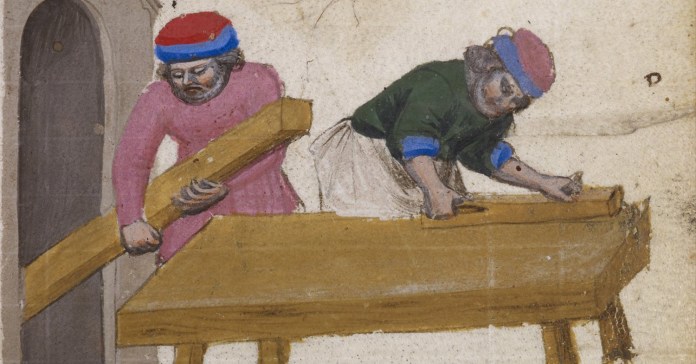
A curious figure named Leo became the bishop of Tours in the year 526. As a priest, his teachings were well-received, and no complaints were written against his theological views by his contemporaries or successors. In terms of a lasting legacy, whereas other bishops were remembered for constructing houses of worship, setting new religious codes, or producing written documents, Leo found a unique way to make a name for himself—he was an artist. When Leo became bishop in 526, he brought with him his paint brushes, sculpting tools, and wood carving equipment. A functioning workshop was set up in Tours and it was there that Bishop Leo could always be found during the personal time granted him between his more priestly duties as head of the bishopric. In his art, Leo dabbled in a variety of mediums, but woodworking was apparently his favorite passion and wooden artworks made up the majority of his projects.

Bishop Leo was skilled at his artistic craft, and he developed a process that allowed him to quickly churn out artworks in quick succession. The time he spent in his workshop was almost obsessive, and from accounts of his period as bishop, Leo could be described as possibly paying more attention to his art than to his duties as the head of the bishopric. These dueling attentions might have led to friction between the bishop and his fellow clergymen if he had not won them over by using his artistic skills to adorn the churches in Tours with specially-crafted art installations. What most impressed the people of Tours were Bishop Leo’s baptismal font covers, carved from wood and either painted or plated with gold. These covers and the interesting holy man who made them were mentioned by one of Leo’s later successors, Bishop Gregory of Tours (c. 539-594, bishop from 573). Gregory wrote, “[Leo’s] hobby was wood-carving. He made a number of pyramidal font-covers, which he then gilded. We still have some of them today. He was talented in other handicrafts, too” (Gregory of Tours, History of the Franks, X.31).

Unfortunately, Leo’s artistic reign as bishop of Tours was incredibly short. After running the bishopric for only six months in 526, Leo died of unknown causes. During those few months, however, Leo had been busy creating artworks that would outlive him and impress further generations of people in Tours.

Written by C. Keith Hansley

Picture Attribution: (Illustration of carpenters from a 14th century manuscript of the Decisions of Isaiah of Trani the Younger (labeled BL Or 5024, f. 184v in the British Library), [Public Domain] via Creative Commons and Europeana).


Sources:

  • The History of the Franks by Gregory of Tours, translated by Lewis Thorpe. New York: Penguin Classics, 1971.

Julius Caesar And His Army Cross The Rubicon, By Bartolomeo Pinelli (c. 1781-1835)

This illustration, by the Italian artist Bartolomeo Pinelli (c. 1781-1835), depicts Julius Caesar’s famous crossing of the Rubicon—a small stream that, in Caesar’s day, marked the boundary between Cisalpine Gaul and Italy. The crossing of the Rubicon occurred in 49 BCE, after negotiations broke down between the soon-to-be dictator and his political and military rivals in Rome. Caesar, whose appointment in Gaul was about to expire, wanted to stay with his loyal army while his agents in Rome orchestrated a political campaign to elect Caesar to high office. The Senate, however, thwarted the general’s plans by refusing to allow Caesar to run for office in absentia. Caesar was uncomfortable with this decision, as he knew that he would be vulnerable to legal and physical attacks from his political enemies during that brief period of time between relinquishing his military command and successfully winning his next election bid in Rome. Furthermore, Caesar questioned the good faith of his opponents, for they had already declared their intention to prosecute him, and they also propped up Caesar’s rival, Pompey, as a champion of Rome who would defend the state. Caesar, unwilling to make himself powerless before his rivals, marched troops across the Rubicon in 49 BCE—as a result, Julius Caesar broke Roman law and defied the Senate by leading his forces out of his assigned province. It was an iconic point-of-no-return moment that marked the beginning of the civil war that transitioned Rome from a republic into an authoritarian empire.

Written by C. Keith Hansley


Sources:

  • War Commentaries by Gaius Julius Caesar and Aulus Hirtius, translated by W. A. McDevitte and W. S. Bohn, 2014.
  • The Twelve Caesars by Suetonius, translated by Robert Graves and edited by James B. Rives. New York: Penguin Classics, 2007.
  • Plutarch’s Lives edited by Charles W. Eliot in the Harvard Classics series. New York: P. F. Collier & Son, 1909, 1937.
  • https://www.rijksmuseum.nl/nl/collectie/RP-P-1929-252

The Fatal Garden Disturbance Of Jian Xuan

Jian Xuan was a government official who served during the reign of Emperor Wu of the Han Dynasty (r. 141-87 BCE). He had an interesting career path, starting out as a minor district secretary and then a provincial office staffer. He was later recruited to an intriguing job as a horse procurer for the renowned general, Wei Qing (died c. 106/105 BCE), and, on a similar note, was eventually appointed as an aid to the imperial stables. After this climb up the ladder, Jian Xuan finally got his big break as a government law official, first being appointed as left prefect of the capital, and then repositioned to supervisor of the right district of the capital city. Jian Xuan had by this time gone from a start in clerking and procurement to a laudable position in the capital city of the Han Dynasty. His future was looking bright, but fate and fortune can take unpredicted twists and turns, especially for those in the service of ruthless emperors. Unfortunately for Jian Xuan, he would be an example of just how quickly and bizarrely one’s destiny could change.

As the story goes, Jian Xuan became embroiled in a workplace feud during his time as a supervisor of the right district of the capital. The rivalry was with an ambitious official named Cheng Xin, who was, at that time, in a subordinate role serving underneath Jian Xuan. During their feud, Jian Xuan uncovered (or manufactured) a crime that Cheng Xin was alleged to have committed. With that leverage on his side, Jian Xuan called for his rival to be arrested. Law enforcers were indeed sent to arrest the subordinate official, and Cheng Xin felt threatened enough to run away. The arresting force had apparently been given orders to take Cheng Xin dead or alive, so they started launching arrows at him as they chased their prey through the capital. During this deadly race, Cheng Xin reached the imperial park and neared a gated garden that Emperor Wu was quite fond of. Cheng Xin was apparently cornered at the gate of this garden, pinned in by bloodthirsty archers. The bowmen launched a volley of arrows at their target, but here is where they made a great mistake. It is unknown how many arrows hit Cheng Xin, or if he lived or died, but the volley of arrows did indeed strike an object. Along with, or instead of, hitting Cheng Xin, several of the arrows that were launched that fateful day happened to slam and embed themselves into the gate of Emperor Wu’s garden. The arrows stuck in the gate did not go unnoticed, and the bizarre occurrence would have deadly consequences for Jian Xuan.

When Emperor Wu was informed of damage done to his garden gate (and the possible killing that occurred in front of it), he was evidently furious. The emperor directed his officials to throw every penalty and punishment at Jian Xuan in consequence of the incident at the gate. Emperor Wu’s court historian, Sima Qian (c. 145-90 BCE), recorded the emperor’s revenge, writing, “Jian Xuan was charged with the responsibility for the incident and was handed over to the law officials for trial. He was convicted of treason and was sentenced to die along with members of his family, but he anticipated the sentence by taking his own life” (Shi Ji 122). Such was the bizarre downfall of Jian Xuan.

Written by C. Keith Hansley

Picture Attribution: (Scenes from festivals of the twelve months, by an unidentified Chinese artist from the late 18th or early 19th century, [Public Domain] via Creative Commons and the MET).

Sources:

  • The Records of the Grand Historian (Shi ji) by Sima Qian, translated by Burton Watson. New York: Columbia University Press, 1993.

The Trojan Women Setting Fire to Their Fleet, by Claude Lorrain (c. 1600-1682)

This painting, by the French artist Claude Lorrain (c. 1600-1682), draws its inspiration from the Aeneid, a poem by the Roman poet Virgil (c. 70-19 BCE) that tells of the journey of Trojan refugees, led by the hero Aeneas, who resettled in Italy after being defeated in the Trojan War. In the scene painted above, Aeneas and his followers had reached Sicily and were torn between settling on the island or pressing on to find a new home on the mainland of the Italian peninsula. The women in the group were said to have been especially anxious to put a stop to their wanderings. As the story goes, the goddess, Iris, infiltrated the group of women and encouraged them to act on their emotions. This resulted in the scene above—the Trojan women marched out to the ships, intending to set them alight. Virgil described the scene:

“Spurring them on and first to seize a deadly brand,
she held it high in her right hand, shook it to flame
and with all her power hurled the fire home.
Astounded, the hearts of the Trojan women froze…
but at first the women wavered, looking back
at the ships with hateful glances, torn between
their hapless love for the land they stood on now
and the fated kingdom, calling still—when all at once
the goddess towered into the sky on balanced wings,
cleaving a giant rainbow, flying beneath the clouds.
Now they are dumbstruck, driven mad by the sign
they scream, some seize fire from the inner hearths,
some plunder the altars—branches, brushwood, torches,
they hurl them all at once and the God of Fire unleashed
goes raging over the benches, oarlocks, piney blazoned sterns.
The ships are ablaze.”
(Virgil, Aeneid, Book 5, approximately lines 710-733)

Such is the scene that is occurring in the painting above. Claude Lorrain seems to have captured the moments early in the episode, at a time when the ships were only beginning to catch fire. No high flickering flames can be seen in the painting, but black smoke is visible billowing up from the decks of many ships floating on the water.  These fires, however, would not last. The smoke was noticed by the hero, Aeneas, and he prayed for the gods to save the fleet. As he was a demigod born from Aphrodite, Aeneas’ pleas had weight. In answer to his prayers, a massive rainstorm appeared over the ships and put out the fires.

Written by C. Keith Hansley


Sources:

Sun Tzu

Sun Tzu (sayings recorded between 6th-3rd century BCE)

“With an understanding of
Weakness and
Strength,
An army
Can strike
Like a millstone
Cast at an egg.”

  • Sun Tzu’s The Art of War (Chapter Five), translated by John Minford (Penguin Classics edition, 2009).