

Anna Komnene (c. 1083-1153)
“Unbroken success can sometimes lead a man who has never met with any reverse to commit an act of madness.”
- The Alexiad (Book III, section 5) by Anna Komnene, translated by E.R.A. Sewter, (Penguin Classics, 2009).

Anna Komnene (c. 1083-1153)
“Unbroken success can sometimes lead a man who has never met with any reverse to commit an act of madness.”

In December of 1520, Hernan Cortes began his second march toward the Aztec capital city of Tenochtitlan. During his previous visit, he had entered the city in peace, but this time, he intended to seize the city by force. During the first months of 1521, Cortes and his coalition of conquistadors and Native American allies made a series of sporadic campaigns against cities and forts splayed around the marshy lake region in which Tenochtitlan was located. The Spaniards backed a new regime in Texcoco, a city that became a headquarters of sorts for Cortes as he planned his operations before moving on to the final push into Tenochtitlan. From the vicinity of Texcoco, he delegated his troops to achieve various tasks, such as ensuring that the Spanish supply line was clear, summoning more allied native forces to participate in the assault, and requisitioning supplies and ammunition from nearby allied villages and cities. With the siege looming and more native allies arriving to campaign alongside the Spaniards, Hernan Cortes reportedly set down a code of conduct that he wanted his Spanish troops to follow. The list of rules addressed Cortes’ greatest concerns—the preparedness of his countrymen for battle at any time, and measures to maintain a working relationship with his native allies.
Among Hernan Cortes’ officers was Bernal Díaz del Castillo, who wrote about the pre-siege code of conduct that was imposed on the conquistadors before the assault on Tenochtitlan was launched. In chapter 148 of his Conquest of New Spain, Bernal Díaz wrote eight instructions that Hernan Cortes reportedly drilled into his troops:
1—There was to be no tolerance of blasphemy among the Spaniards in Cortes’ army. They were on the eve of a great battle after all, and it was inadvisable to anger God before putting lives on the line.
2—Spaniards were to treat their native allies with respect and restraint. Infighting or otherwise causing allies to end their cooperation with the Spaniards would be detrimental to the campaign of besieging and capturing Tenochtitlan.
3—No Spaniard was to leave his designated camp or post without express permission or command from his officer.
4—All conquistadors were expected to wear all of their armor during all parts of the day, no matter what they happened to be doing at the time. They needed to be able to respond immediately and effectively to whatever the cornered Aztec capital city could throw their way in the upcoming days.
5—Gambling with armor, weapons and especially horses as stakes was prohibited on pain of great punishment for those caught disobeying this order.
6—In rule 4, Cortes ordered his troops to wear armor at all times. Rule 6, however, reminded his Spaniards that even while sleeping they were expected to be still fully armored and armed. Only severely sick or wounded conquistadors were allowed to shed some pieces of equipment.
7—As being prepared to fend off attacks at any moment was of utmost importance, any Spaniard found sleeping during his guard duty, or otherwise neglecting his job as a lookout, could face the penalty of execution.
8—As rule 3 ordered the Spaniards to remain at their camp or post at all times, rule 8 further tightened this command by prohibiting conquistadors from sneaking off to mingle with different camps led by commanding officers other than their own.
Written by C. Keith Hansley
Picture Attribution: (Illustration of Hernán Cortés from Cassell’s Illustrated Universal History, [Public Domain] via Creative Commons, Europeana and The British Library).
Sources:

An unknown artist made this artwork, currently held by the Biblioteca de Catalunya and the Digital Memory of Catalonia. It depicts the mightiest warrior in the Trojan army, Hector, bidding farewell to his family before marching off to face the Greek coalition that was invading Troy under the leadership of formidable officers like the legendary Achilles and Odysseus. As the Trojan War was said to have been a decade-long affair, there would have been many farewells between Hector and his family, but the artwork likely draws most of its inspiration from a specific farewell scene featured in book 6 of Homer’s Iliad. As the story goes, that particular encounter began with both Hector and his wife, Andromache, frantically wandering their city, looking for each other. Andromache, tailed by her young son being held by a nurse, finally found Hector by the city gates. On their meeting, Homer wrote, “Hector raced out of the house and retraced his steps down the well-built streets. He had crossed the great town and reached the Scaean gate—his route out on to the plain—when Andromache herself, who married him with a rich dowery, came running up to meet him…and her waiting-woman carried the little boy in her arms, their baby son and Hector’s darling, lovely as a star…” (Homer, The Iliad, book 6, approximately lines 390-400).
It was an encounter featuring a wide array of emotions, with the family sometimes sharing in laughter and other times tears. Homer, especially while describing the interactions of the parents with their son, brought to life with his words the mixture of nervous laughter and foreboding sadness that the family was experiencing. Homer wrote:
“Hector reached out for his boy. But the child shrank back with a cry to the bosom of his girdled nurse, alarmed by his father’s appearance, terrified by his bronze helmet with its horsehair plume that he saw nodding frighteningly from the top. His father and lady mother burst out laughing. Glorious Hector quickly took his helmet off and put it, all shining on the ground. Then he kissed his dear son, dandled him in his arms and prayed to Zeus…With these words Hector handed the boy into the arms of his wife, who took him to her fragrant bosom, laughing through her tears” (Homer, The Iliad, book 6, approximately lines 465-485).
Like Homer’s scene, the artwork also shows Hector bidding farewell to his wife and son near the city gate. Hector can be seen grasping Andromache’s hand, and, behind them, their young son can is being lifted up between his parents’ heads. Although it is difficult to ascertain if the image depicts the beginning or the end of the farewell scene, perhaps it is the latter, due to Hector having one foot in a chariot and a spear in his hand. Whatever the case, after some final words by Hector about how no one can escape death and that he would rather die a hero than survive as a coward, the Trojan champion finally pulled himself away from his family and marched off to continue his doomed struggle against Achilles and the Greeks.
Written by C. Keith Hansley
Sources:

Sima Xiangru (c. 179-117 BCE)
“To think only of one’s own pleasure before sufficient benefits have been bestowed upon others; to ignore the common people and neglect the government of the nation, merely because one is greedy for a catch of pheasants and hares—this no truly benevolent ruler would do!”

According to ancient folklore and legend, a certain Xu Fu made contact with the First Qin Emperor (r. 221-210 BCE) and claimed that he had a lead on finding three evasive spirit mountains—huge and mobile supernatural landmasses which, like mirages, could be seen but not reached in the Gulf of Bohai region. These spirit mountains, according to the legends, served as homes to a mysterious community of supernatural Chinese entities, known collectively as “the immortals.” Xu Fu claimed he had discovered specific spirit mountains called Fangzhang, Yingzhou and Penglai, of which the last was seemingly the most important. From these magical islands, an elixir (or herb) of immortality could reportedly be obtained, which was something that the First Emperor was eager to possess.
Xu Fu must have been a charismatic and persuasive man, for the First Emperor of Qin (who was obsessed with the supernatural realm and immortality) decided to place Xu Fu in command of a large expedition tasked with exploring the Gulf of Bohai and making contact with the spirit mountains. In his enthusiasm, the emperor spent a fortune on the expedition, allegedly recruiting thousands of explorers to accompany Xu Fu and providing the expedition members with enough ships for their seaborne search. Yet, despite the more-than-adequate funding and the large manpower involved in the search, Xu Fu never made any progress in his expedition—after all, he was searching for ghostly spirit mountains of legend. Xu Fu, however, reportedly kept the emperor interested and invested in the expedition by sending in fantastical reports. He came up with a number of odd excuses for his inability to find the magical mountain abodes, such as suggesting that magical barriers guarded the islands and that hostile aquatic guardians patrolled the gulf. According to the historian, Sima Qian (c. 145-90 BCE), one such message to the First Emperor read, “The herbs of Penglai can surely be obtained. But always there are large fish that cause difficulty, and therefore we are unable to reach the island” (Shi Ji, 6). In response, the emperor reportedly gave the explorers fishing gear and, for the biggest of fish, repeating crossbows.
Xu Fu likely knew that he could not keep the charade up forever. He would not be able to provide the emperor with immortality-bestowing herbs, and heads would roll when the truth came out. Therefore, Xu Fu decided to prepare an exit plan, and he used his influence over the emperor to get the government to provide him everything he needed to start a new life abroad. The aforementioned historian, Sima Qian, recorded the conclusion to the fantastical and folkloric story of Xu Fu, writing:
“[T]he First Emperor of the Qin sent Xu Fu to sail over the sea in search of the spirits, and he returned and lied to the emperor, saying, ‘In the midst of the sea I met a great spirit who asked me if I were the envoy from the Emperor of the West. When I answered that I was, he asked me what I was seeking for. ‘I am looking for the medicine which increases one’s years and brings long life,’ I said. ‘Your King of Qin,’ replied the spirit, ‘is too stingy with his courtesy! You may see the medicine, but you cannot take it back with you!’ Then he led me to the southeast, to the mountain of Penglai, where I saw palaces and towers surrounded by lawns of grass. There was a messenger there, copper-coloured and shaped like a dragon, with streams of light pouring from his body and lighting up the sky. When I saw him I bowed before him twice and asked, ‘What sort of offerings should I bring?’ and the Sea God (for that was what he was) replied, ‘If you will bring me the sons of good families, and beautiful maidens, along with the products of your various craftsmen, then you may have the medicine!’” (Sima Qian, Records of the Grand Historian, Shi ji 118).
As the bizarre tale goes, Xu Fu’s imaginative account, with its cast of spirits, spirit mountains and dragonesque gods, was highly compelling to the ears of the supernatural-obsessed First Emperor. The items supposedly requested by the Sea God were said to have been quickly gathered by the emperor, and Xu Fu gladly took possession of the personnel and materials on the pretense of bringing them as an offering to the spirit mountain residents. Yet, of course, Xu Fu did not really intend to bring the caravan of people and goods to the Gulf of Bohai. He had more personal intentions. As told by the historian Sima Qian, “When the First Emperor heard this [account from the explorer], he was overjoyed and immediately sent Xu Fu back east again, accompanied by 3,000 boys and girls of good families and bearing presents of seeds of the five types of grains and articles produced by the various craftsmen. But when Xu Fu reached Pingyuan and Guangze, he halted his journey, made himself king of the region, and never returned to the Qin” (Shi ji 118). And so, after wasting the emperor’s time and squandering a great amount of the government’s money, Xu Fu reportedly was able to escape with treasure and followers. As for the First Emperor, even after the expedition leader’s disappearance, he evidently continued to believe in Xu Fu’s stories about there being spirit mountains and magical beings at the gulf. In keeping with this, the First Emperor was said to have been touring the coastline of the Gulf of Bohai (and hunting for giant fish) when he fell ill and died in 210 BCE.
Written by C. Keith Hansley
Picture Attribution: (Panel with immortals, dated to the Qing dynasty (1644–1911), [Public Domain] via Creative Commons and the MET).
Sources:

This engraving, by an unknown artist influenced by Pierre-Antoine Labouchère (c. 1807 – 1873), re-creates events around the publication of the Ninety-five Theses or Disputation on the Power and Efficacy of Indulgences by Martin Luther (c. 1483-1546). As the story goes, Martin Luther hammered his Ninety-five Theses onto a church door in Wittenberg on October 31, 1517. Although Luther may have meant the act to be a harmless proposal of debate on the Catholic Church’s most controversial practices, the posting and subsequent printing-press-aided mass dissemination of his Ninety-five Theses became a catalyst for the Protestant Reformation. The artwork seems to bring to life the commotion that occurred after Luther’s public posting of his thought-provoking writing.
Written by C. Keith Hansley
Sources:

Pliny the Younger (c. 61/62-113)
“How often we judge actions by the people who perform them! The self-same deeds are lauded to the skies or allowed to sink into oblivion simply because the persons concerned are well known or not.”
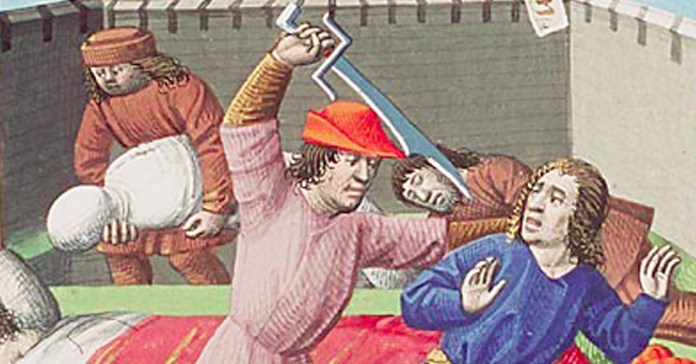
In the 6th century, there lived a man named Eulalius who ruled as a count over the Frankish-controlled region of Clermont-Ferrand. Although he was not one of the top noblemen or power players of the age, his peculiar interactions with other nobles and the Frankish legal system made him a household name to members of 6th-century Frankish society who kept their ears open for the realm’s latest gossip. One such avid listener to the news was Bishop Gregory of Tours (c. 539-594), who wrote a contemporary Ten Books of Histories, also commonly known as the History of the Franks, which covered events that occurred during Bishop Gregory’s own life. Chaotic wars and brutal dynastic intrigue between the Frankish kingdoms were the main focus of Gregory’s work, and once again, it should be said that Count Eulalius was in no way a leading character in the overarching narrative that the bishop recorded. No, Count Eulalius was not a leader of armies or a statesman masterminding the kingdom’s administration behind the scenes—therefore, you would not find him mentioned in accounts of battle or described as having any meaningful influence in the throne rooms of the Frankish kings. Instead, in Gregory of Tours’ account of the 6th century, you are more likely to find brief mentionings of Count Eulalius scattered in digressions here and there about a marriage that Eulalius was involved in or some crime that Eulalius was accused of. Curiously, as Count Eulalius’ marriages and crimes were both several in number, Bishop Gregory of Tours ended up recording quite a few tales about the unscrupulous count. Most of these tales can be found scattered in volumes 8-10 of Gregory’s history, and although the stories do not come close to a complete biography of Eulalius, they nevertheless can be combined to present a colorful outline of the count’s infamous life.
According to Gregory of Tours, Eulalius was born in the Clermont region sometime before the year 571. Fair warning, Gregory’s account of Eulalius’ childhood (as well as every other stage of his life, for that matter) is heavily laced with bias and innuendo of evil and villainy—even so, there are likely grains of truth to the legends, and it is better to have folktales than nothing at all. Eulalius, so the story goes, was an unruly child who often clashed with his parents, especially his mother. When she subsequently died suspiciously, the local populace and authorities strongly suspected that young Eulalius was somehow involved in his mother’s demise. On this tale, Bishop Gregory of Tours wrote:
“As young men often do, Eulalius used to behave in an irresponsible fashion. The result was that his mother frequently had reason to chide him, and in the end he came to hate her whom he ought to have loved. After the servants had retired to bed, it was his mother’s habit to go off to pray in her oratory and to keep the night vigils there, making her tearful supplications to God. She was found garrotted, still wearing the hair-shirt which she put on when she prayed. No one knew who had done this, but her son was strongly suspected of having murdered his mother. As soon as Cautinus, the Bishop of Clermont, came to hear of this, he cut Eulalius off from communion” (Gregory of Tours, History of the Franks, 10.8).
This unflattering story makes up the bulk of the knowledge about Eulalius’ childhood. In summary, he did not seem to get along with his parents (his father is not mentioned), his mother was reportedly murdered, and there was enough evidence against Eulalius for the young man to be excommunicated from the local church after his mother’s death. Eulalius did manage to regain access to the church’s communion relatively quickly, however, and there is no mention of him ever suffering any real legal trouble from the government regarding his mother’s death. Make of it what you will regarding his guilt or innocence, but the gossip that he may have murdered his mother apparently lingered for the rest of Eulalius’ life. As a side note, the Bishop Cautinus featured in the quote is known to have died in 571, and his role in the story is the reason why we know Count Eulalius was born before that 571 date.
Next time we hear of Eulalius, time had skipped forward to his wedding day. He married a noblewoman named Tetradia, and their fates would be intertwined for the rest of their lives. Yet, instead of a picturesque love story, the couple would unfortunately turn out to be life-long enemies. Eulalius, following his usual character traits, was said to have been a cheating and abusive husband. When he was not pursuing maids or beating his wife, the count could also be found squandering the family’s money. Eulalius’ behavior and expenditures apparently even surprised and appalled his own relatives, eventually causing one of Eulalius’ own nephews, named Virus, to go out of his way to intervene on behalf of the battered wife, Tetradia. Summarizing these details up to this point in the story, Gregory of Tours wrote:
“[Eulalius] had married Tetradia, through her mother a young woman of noble blood, but of humbler origin on her father’s side. He was in the habit of sleeping with the women-servants in his household. As a result he neglected his wife. He used to knock her about when he came back from his midnight exercises. As a result of his excesses, he ran into serious debt, and to meet this he stole his wife’s jewelry and money. In the appalling straits in which she found herself, Tetradia gradually lost all standing in the marital home. Eulalius had occasion to go off to see the King. During his absence a man called Virus, who was her husband’s nephew, fell in love with Tetradia. He had lost his own wife and wanted to marry her. He was afraid of what his uncle would do to them both, so he sent Tetradia off to Duke Desiderius…” (Gregory of Tours, History of the Franks, 10.8).
When Tetradia fled, she did not leave empty handed. She grabbed whatever valuables had survived Eulalius’ debt-fueled plundering, and she also took with her a son that was old enough to travel. On these developments, Gregory of Tours wrote, “She took with her all her husband’s property, gold, silver, clothing, everything in fact which she could carry. She also took her elder son, leaving her younger boy behind” (History of the Franks, 10.8). While Tetradia fled to the safety of Duke Desiderius—a top military commander who served with varying degrees of loyalty under the Frankish Kings Chilperic (r. 561-584), Guntram (r. 561-593) and Childebert II (r. 575-595)—Virus unwisely decided to lag behind. As a result, Virus was still in the vicinity when Eulalius returned home to find out that his wife, eldest son, and a large amount of household belongings were gone.
Through unexplained means, Eulalius was able to deduce a clear picture of what had happened, including the role of Virus played in Tetradia’s escape. Despite their uncle-nephew relationship, Eulalius was filled with rage at Virus over the incident and eventually chased him down. Concerning these events, Gregory of Tours wrote, “When Eulalius came back from his journey he discovered what they had done. For a while he took no action, nursing his resentment. Then he attacked his nephew Virus and killed him in one of the narrow defiles of Auvergne” (History of the Franks, X.8). Killing Virus, however, did not solve Eulalius’ marriage situation. Tetradia had already reached the safety of Duke Desiderius, and the duke decided to take her in and offer her protection. As it happened, Duke Desiderius was a widower, and after he and Tetradia got along well during the time they spent together, the duke decided to ask Tetradia to marry him. She agreed to the proposal, but as Tetradia was already married, her new union with Duke Desiderius became a national incident. Eulalius began preparations to bring the case to court, but, in a curious turn of events, other nobles and even King Guntrum intervened on the side of Tetradia. As told by Gregory of Tours, “Duke Desiderius hurried off to see King Guntram, taking with him Antestius, Abbot Aredius and a number of bishops…At this same time Eulalius was also there, for he was preparing to bring a lawsuit about his wife, who had left him and gone to live with Desiderius. However, he became the subject of so much ridicule and humiliation that he decided to remain silent. Desiderius received presents from the king and came back home” (History of the Franks, 8.27). Count Eulalius, knowing he was outranked and politically outmaneuvered by Duke Desiderius, decided to drop the issue for the time being.
With Tetradia out of reach, Eulalius eventually remarried. Instead of trying to learn from his mistakes and achieve a normal relationship, Eulalius ended up embarking on an even more scandalous journey of courtship and marriage than the last one. As told by Gregory of Tours, “Eulalius abducted a nun from a convent in Lyons and made her his wife” (History of the Franks, 10.8). This sacrilegious move caused a stir in the community and it earned Eulalius enemies from the nuns family, as well as from more of his own relatives. Just as had happened at other points in his life, Eulalius’ critics began mysteriously dying and the infamous count was rumored to have been the culprit. According to Gregory of Tours, “A little later Eulalius assaulted Emerius, who was one of the nun’s cousins, and killed him. Then he killed Socratius, the brother of his own half-sister…He committed a number of other crimes which I have no space to relate” (History of the Franks, 10.8). Such was the villainous life that Eulalius was living as he stayed out of Duke Desiderius’ way. Desiderius, however, was no immortal, and as the duke frequented the field of battle, he often put himself at risk.
Around 587, Duke Desiderius embarked on an ambitious raid into the lands of the Frankish Empire’s southern rivals—the Visigoths. As the story goes, the duke called in help from only one other nobleman before he launched his attack. This ally was Count Austrovald, who marched with Duke Desiderius down toward the Pyrenees. How far the daring noblemen were planning to push into Visigoth territory is unknown, but their first target was the city of Carcassonne, on the French side of the Pyrenees Mountain chain. What allegedly happened next was recorded by Gregory of Tours (c. 539-594):
“The Carcassonnais got wind of this, for the news reached them early, and they made their preparations, being determined to resist. The battle began, the goths turned in flight and Desiderius with Austrovald at his side attacked their rear. As the Goths continued their retreat Desiderius came near to the town, accompanied by only a handful of his troops, for his men’s horses were exhausted. As he rode up to the town-gate, he was cut off by the inhabitants, who had been lurking inside their walls. Desiderius was killed, together with all the men who had kept up with him” (History of the Franks, 8.45).
With the downfall of Duke Desiderius, Tetradia lost her protector. She also discovered that her social network and acquaintances were fair-weather friends, for they abandoned her after her powerful husband died. Count Eulalius was quick to realize his ex-wife’s weakened position and he eagerly renewed his much-delayed plans to bring Tetradia to court. This time, Duke Desiderius’ influence was not able to override Eulalius’ schemes. Instead, the count’s charges were taken up by the court and Tetradia suffered greatly. As told by Gregory of Tours:
“Eulalius pleaded his own case against her. He demanded restitution of the property which she had taken when she went off to Desiderius. The verdict was that Tetradia should repay fourfold all that she had taken. The sons which she had borne to Desiderius were declared illegitimate. It was agreed then that if she paid back to Eulalius all that she had been ordered to pay, she might return to Clermont without let or hindrance and have there the free use of what she had inherited from her father. All of this was done.” (History of the Franks, 10.8).
So ended Tetradia’s long streak of leverage against her ex-husband. Following the death of Duke Desiderius, Tetradia’s children were disenfranchised, she had to pay back four times what she took from Eulalius’ home, and she was banished from Clermont until she paid over what was ordered by the court. Unfortunately, other than the “All of this was done” quote, Gregory of Tours did not elaborate any further on the chaotic tale of Tetradia and Eulalius, leaving the story of the rest of their lives a mystery.
Written by C. Keith Hansley
Picture Attribution: (Cropped manuscript illustration, attributed to Maïtre François, [Public Domain] via the Koninklijke Bibliotheek and Europeana.jpg).
Sources:

This painting, by the Greek artist Vasilios Chatzis (c. 1870–1915), recalls the awkward Fourth Crusade, when Christians crusaded against Christians. This bizarre series of events began around 1201, when the European kingdoms were once again riling themselves up for another crusade campaign. During previous crusades, Christian armies had ventured through Constantinople’s territory in Greece and Anatolia to reach their targets in the Holy Land. The crusaders, however, turned out to be unruly and destructive guests in these earlier wars, so when the Fourth Crusade was about to begin, the emperor of Constantinople barred the crusading armies from the borders of his empire. Initially, the crusaders decided to accept the decision and planned to transport their forces by sea instead of land.
After reassessing the situation, the crusaders of the Fourth Crusade chose to set sail from Italy, with Venice being the designated hub for transportation. Venice did not host the crusaders out of charity—they drove a hard bargain in their terms and conditions. Per the agreement, once the crusaders reached their bountiful destination, Venice wished to keep 3/4 of the loot, 3/8 of the captured territory and 1/2 of the positions on a council to choose the next ruler of the seized territory. Furthermore, the Venetians began to manipulate the crusaders into pursuing a new target for their campaign. In this regard, Venice’s recent history at that time should be addressed. Venice had been a former ally of Constantinople, but by the Fourth Crusade, they were bitter enemies. With a huge army delivered to their harbor, the Venetians began contemplating a plan to strike a blow against their imperial foe. Therefore, when the crusaders agreed to Venice’s terms in 1204, the army was packed onto ships and sent not to the original target of the Holy Lands, but instead on course for Constantinople.
At the time, Constantinople was arguably the greatest Christian city of its day. Nevertheless, the crusaders caught the city, and its emperor, completely off guard. For around three days, the crusaders brutalized the city of Constantinople, killing its inhabitants, looting its wealth, and vandalizing its structures. With the emperor of Constantinople ousted, and the empire in disarray, the crusaders and Venice founded their own Latin Empire in Constantinople and Greece that lasted from 1204 to 1261. Such are the events that inspired Vasilios Chatzis’ artwork.
After decades of occupation, the Crusaders were eventually driven from Constantinople. Nevertheless, the empire never fully recovered. The destabilization and damage caused by the Fourth Crusade proved fatal for Constantinople as its enemies only continued to grow stronger. In 1453, Constantinople, and its empire, fell to Sultan Mehmed II of the Ottoman Turks.
Written by C. Keith Hansley
Sources:

Heraclitus (c. 540-480 BCE)
“This world-order (kosmos) was made neither by god nor by man, but it was always and is and shall be; fire ever-living, being kindled by measures and being quenched by measures.”


